
SIERRA STREAMS
Watershed Monitoring, Research, & Restoration

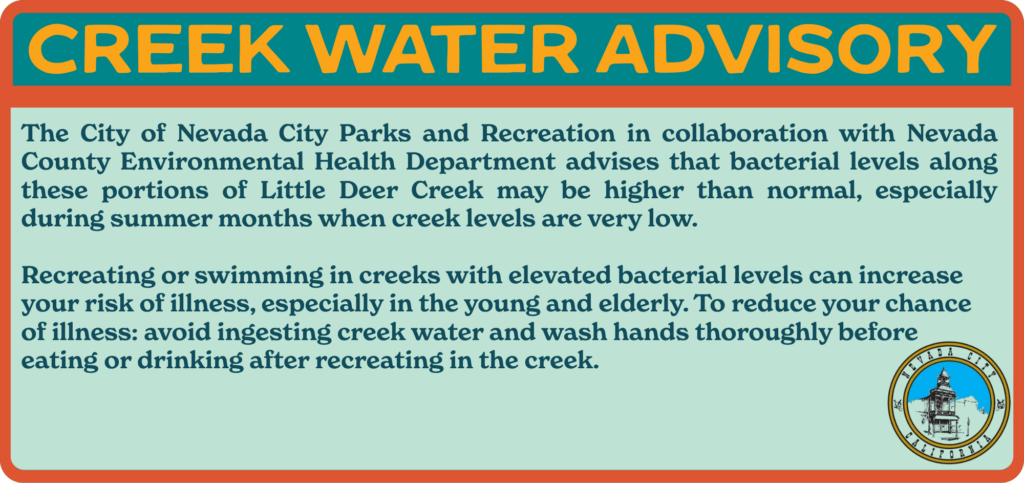
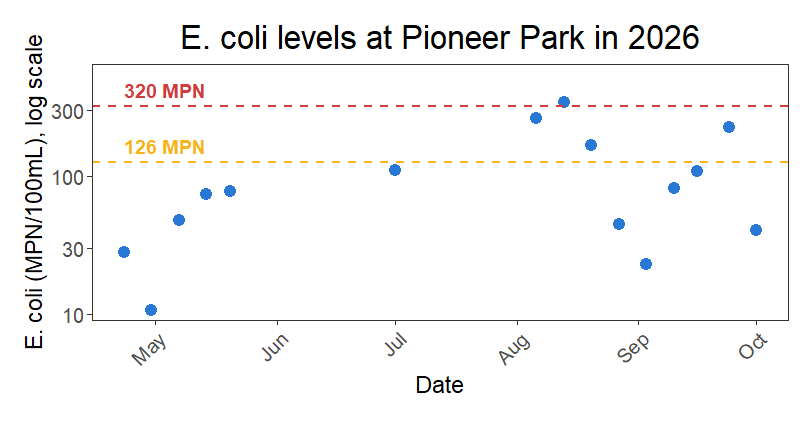
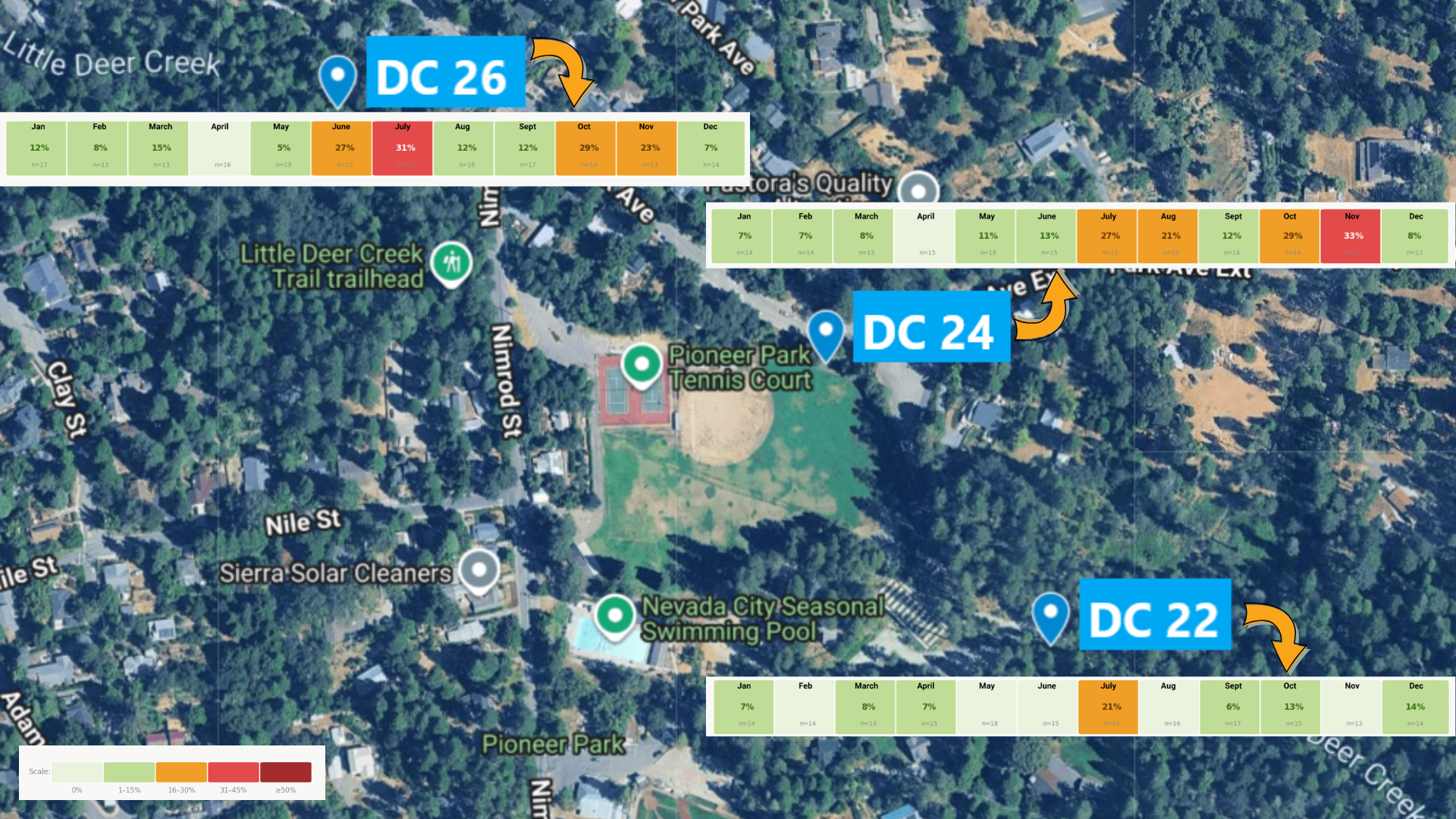
Sierra Streams Institute monitors three sites in and around Pioneer Park along Little Deer Creek: one above the park (DC 22), one in the park (DC 24), and one just past the park (DC 26). During summer and fall months, E. coli levels often rise above the EPA threshold for safe water. When E. coli levels are above the EPA threshold, SSI informs the City of Nevada City and begins targeted monitoring of our Pioneer Park sites to track these levels throughout the summer and fall.
Escherichia coli, or E. coli, is bacteria that is commonly found in the lower intestine of warm blooded organisms, like us and our pets. While most kinds are harmless and part of a healthy intestinal tract, some E. coli can lead to gastrointestinal illnesses, and most importantly the Environmental Protection Agency has identified E. coli as an indicator of the likely presence of other harmful bacteria. E. coli is transmitted through ingestion, which can be through food or water, and through the blood stream. Community members with increased risk for E. Coli infections include: Children under 5, Adults 65+, people with weakened immune systems, and international travelers.
What can you do to prevent E. Coli related gastrointestinal illnesses?
This may seem like the most obvious answer, but do not drink water from the stream; most adults probably already know this. However, if you bring babies or toddlers in the stream they likely don’t realize they shouldn’t drink the water and could easily swallow a mouthful of contaminated stream water. You also shouldn’t get into the stream if you have any open wounds, as bacteria can get directly into your bloodstream. If you do choose to go into the stream, make sure to thoroughly wash your hands afterwards as bacteria on your hands can transmit to your food or anything else you touch.
What is causing the spike in E. Coli in Little Deer Creek?
The quick answer to this question is we simply aren’t sure. Although we see some increase E. coli values at site DC22, the majority of the higher than EPA threshold values are found at sites DC24 and DC26. These two sites are downstream from the bathrooms and dog play area. During the summer, Little Deer Creek experiences periods of low flow meaning that the water is not moving as quickly as it would in the Winter and Spring. While we cannot pin point the main cause of the E. coli contamination, we are hoping to learn more about the trends at each site this summer.
In order to answer this question, there are a few pieces of background information that are helpful to understand. In freshwater systems that are not a drinking water source, the presence of E. coli is not an immediate cause for concern. Low levels of E. coli in water are not considered an immediate danger to human health. It’s when E. coli is present in high concentrations that individuals exposed to that water are at a heightened risk of getting sick due to a fecal-borne pathogen. E. coli is used as an indicator organism that can help identify fecal contamination and the possible presence of pathogenic bacteria and viruses.
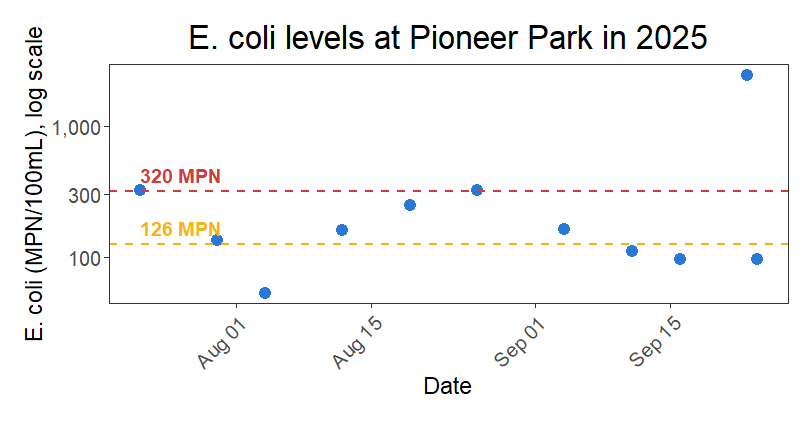
An additional useful piece of information is that there are multiple guidelines for bacteria concentrations depending on how often a waterway is monitored. While Sierra Streams Institute would love to monitor every creek every day, that just isn’t feasible. Since we monitor on a quarterly (every 3 months) basis, we use the EPA threshold for E. coli of greater than 320 colony forming units (CFU) in 100 mL of water. When water is monitored on a more frequent basis, that value is a 30-day average greater than 126 CFU in 100 mL of water.
This means that the initial Nevada City Public Notice that Little Deer Creek was “above the EPA threshold” means that there were concentrations of E. coli in the water greater than 320 CFU/100 mL of water during our single sampling event. During follow-up monitoring, the E. coli levels will need to drop below an 30-day average value of 126 CFU/100 mL OR if a sample is taken more than 30 days from a previous sample, bacteria needs to be lower than 320 CFU.
Without performing a rigorous study of the system, Sierra Streams Institute can’t provide a concrete answer. However, there are multiple factors that may contribute to the elevated E. coli levels in Little Deer Creek during the summer.
Foremost is that summertime in California means less water in our creeks and streams. With less water in the creek, any contaminants that were picked up in the watershed are concentrated. This also helps explain why Deer Creek has lower bacteria levels than Little Deer Creek. Since Little Deer Creek is a much smaller system, any constituents tagging along with the water are diluted by Deer Creek’s additional volume.
If you’re interested in helping get to the root of this problem, you can donate to SSI and help us fund further bacteria testing in Little Deer Creek!
The 2025 spike in E. coli levels lasted longer than previous years with higher values lasting from July 2025-January 2026. This graph shows the geometric mean data collected during that spike:
Click the blogs below to learn more: