UPDATE – E. coli at Pioneer Park
As we transition from the end of the summer heat into cooler temps and some early season rain, Sierr...

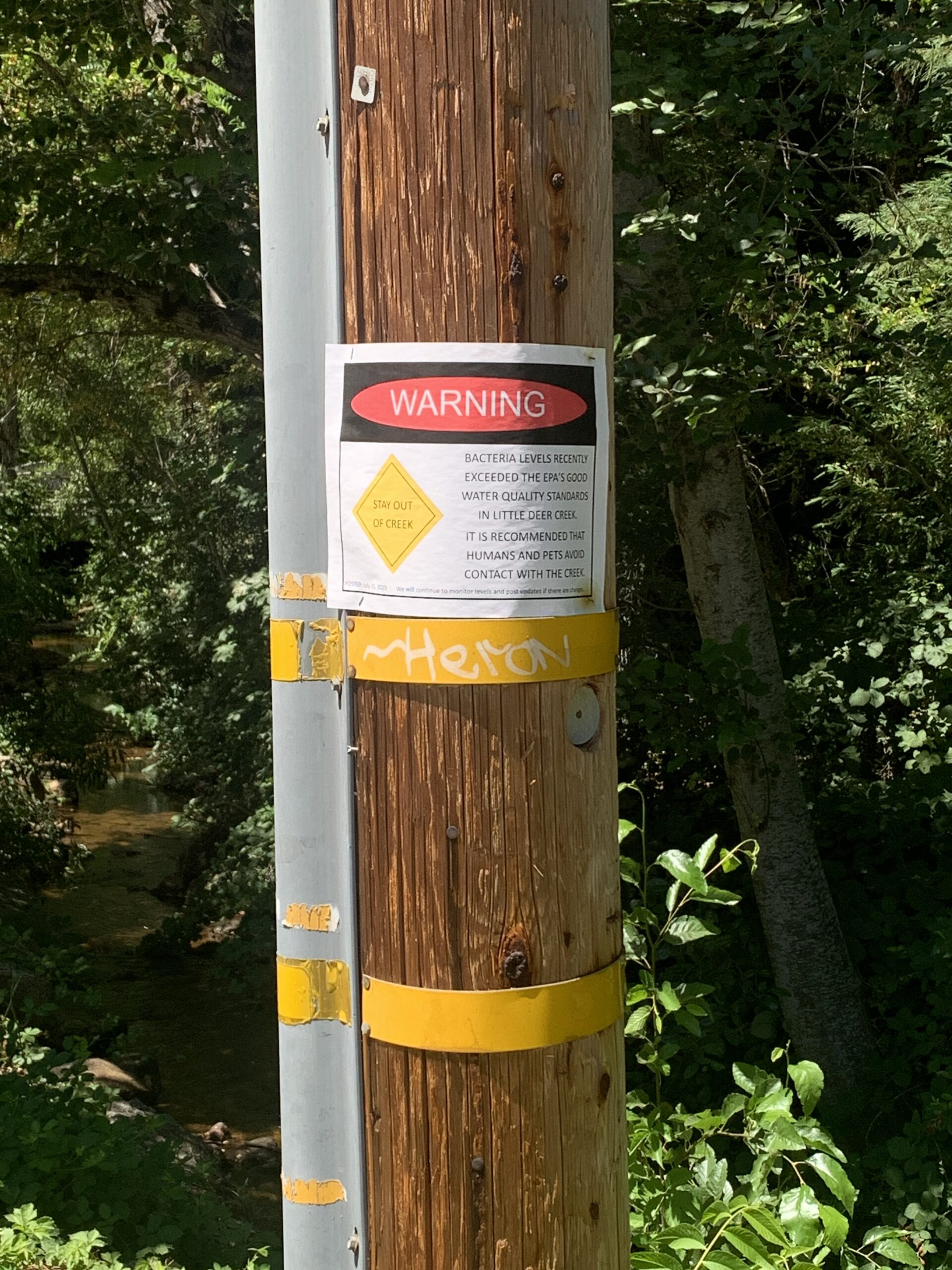
Nevada City is abuzz with the news that Little Deer Creek in Pioneer Park has E. coli levels above the EPA threshold for safe water. While this news can feel alarming and lead to uncertainty, we’re here to help you understand what the current Public Notice means and to provide some additional resources you can use to determine when or if it is safe to swim at your favorite local swimming hole. Take a look at this list of FAQs, and please don’t hesitate to reach out to our monitoring team if you would like more information.
In order to answer this question, there are a few pieces of background information that are helpful to understand. In freshwater systems that are not a drinking water source, the presence of E. coli is not an immediate cause for concern. Low levels of E. coli in water are not considered an immediate danger to human health. It’s when E. coli is present in high concentrations that individuals exposed to that water are at a heightened risk of getting sick due to a fecal-borne pathogen. E. coli is used as an indicator organism that can help identify fecal contamination and the possible presence of pathogenic bacteria and viruses.
An additional useful piece of information is that there are multiple guidelines for bacteria concentrations depending on how often a waterway is monitored. While Sierra Streams Institute would love to monitor every creek every day, that just isn’t feasible. Since we monitor on a quarterly (every 3 months) basis, we use the EPA threshold for E. coli of greater than 320 colony forming units (CFU) in 100 mL of water. When water is monitored on a more frequent basis, that value is a 30-day average greater than 126 CFU in 100 mL of water.
This means that the initial Nevada City Public Notice that Little Deer Creek was “above the EPA threshold” means that there were concentrations of E. coli in the water greater than 320 CFU/100 mL of water during our single sampling event. During follow-up monitoring, the E. coli levels will need to drop below an 30-day average value of 126 CFU/100 mL OR if a sample is taken more than 30 days from a previous sample, bacteria needs to be lower than 320 CFU.
Sierra Streams Institute will be continuing to check E. coli levels in the creek on a weekly basis. As soon as E. coli levels are consistently below the EPA threshold SSI will notify the City and the Public Notice will come down. In the meantime it is important to exert discretion when you recreate around the water.
You can also help us test the water quality here (or in other locations) more often by donating. SSI is not paid by the City to monitor water quality, so we rely on support from the community to help us test the water and keep everyone safe!
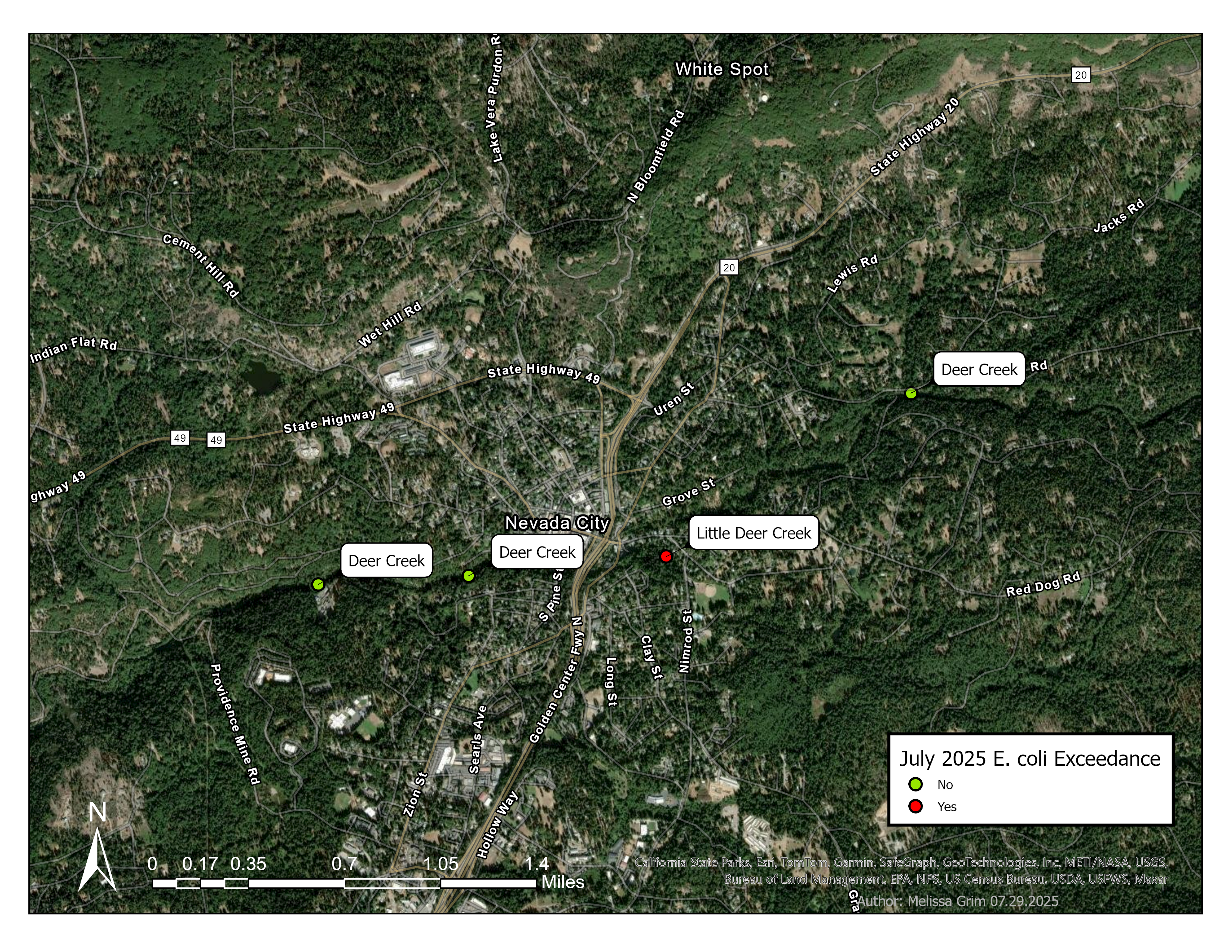
Great question! During our July monitoring (July 6 – July 17) the only SSI monitoring location above the EPA threshold for E. coli was Little Deer Creek. We still encourage swimmers and splashers to use their best judgement while recreating in our cool and refreshing waters, as summer time can lead to concentrated bacteria levels as water levels drop.
You can see a map below of locations that we monitor in and around Nevada City. Points in red are above the EPA threshold (Little Deer Creek) while points in green are below the threshold.
Sierra Streams Institute does not monitor water quality in Scott’s Flat Reservoir, so we don’t know what the E. coli levels are in the lake.
Sierra Streams Institute does not monitor water in the Yuba, so we can’t speak to E. coli levels there. If you’re interested in Yuba swimming holes, we encourage you to reach out to SYRCL’s monitoring program.
The state of California has developed resources to help recreationalists in the water determine where it’s safe to swim. We encourage you to check out the “Safe to Swim” map and additional real-time water quality resources offered by the state. You can find these resources on the California Water Quality Monitoring Council website.
Without performing a rigorous study of the system, Sierra Streams Institute can’t provide a concrete answer. However, there are multiple factors that may contribute to the elevated E. coli levels in Little Deer Creek during the summer.
Foremost is that summertime in California means less water in our creeks and streams. With less water in the creek, any contaminants that were picked up in the watershed are concentrated. This also helps explain why Deer Creek has lower bacteria levels than Little Deer Creek. Since Little Deer Creek is a much smaller system, any constituents tagging along with the water are diluted by Deer Creek’s additional volume.
If you’re interested in helping get to the root of this problem, you can donate to SSI and help us fund further bacteria testing in Little Deer Creek!
The number one way you can help us is to consider donating or becoming an SSI member. Our monitoring program is primarily funded by donations, so to monitor E. coli levels in our local waterways we rely on support from the community during these targeted monitoring events to help us provide higher frequency monitoring!
If you aren’t able to donate, we still appreciate help from our volunteer water quality monitors. Learn more about becoming a volunteer here.
For more information about our monitoring efforts you can reach out to our monitoring team via email lab@sierrastreamsinstitute.org, swing by our office at 117 New Mohawk Rd. in Nevada City, or leave us a message at (530) 470-6037 x1.











BARRY BYRNE says:
Well, what where the levels????
Melissa Grim says:
Hi Barry,
That’s a great question. As of 8/13 the bacteria levels are at 169 MPN/100 ml (MPN = most probably number, a slightly different method of analysis than CFU discussed in the article). This means levels are still above the rolling 30-day average threshold of 126 CFU. We will update the article and City once that average is below 126.
Best,
Melissa
Jessica says:
Deer creek runs next to my property and I like to soak in it sometimes. Is there a digital notice posted anywhere or do I need to go into town to look at paper notices posted at certain sites? I would love a link to check the water quality online if that exists.
Melissa Grim says:
Hi Jessica,
The only digital resources we are aware of are the ones we provided links to in this guide. If and when we become aware of a water quality issue at one of our monitoring sites (on Deer Creek or the Bear River), we report it to the relevant county and/or city authorities who are responsible for putting out a public notice. Hopefully the links we’ve provided in the section “Is it safe to swim in other parts of Deer Creek? What about the Yuba River? And Scotts Flat?” can help you find what you’re looking for.
We are internally working on developing an easily digestible format for our monitoring data so that it is publicly accessible, but this will take time! We will happily share updates as they come and continue reporting any water quality issues we are aware of to the relevant authorities.
If you would ever like to test the water near your swimming hole, we can happily provide that service. You can learn more in our new blog post: Water You waiting for? Get your water tested now with our Laboratory Services!
Warmly, Melissa
Sam Bell says:
Happy to help! Glad you found is useful.