
In the Spring it is hard not to be bombarded by the vast blooming yellow flowers of Scotch Broom. Whether you love or hate the sight, these species of invasive plants are problematic to wildfire prone areas like Nevada County. So let’s take a deep dive into the problem with Scotch Broom and what we can do to prevent its spread.

Large Scotch Broom bush. Photo by Don Henise (Link)
Let’s Talk Invasive Plants
We have all heard the hype about invasive plants, but how bad are they really? According the the US Forest Service, invasive plant species contribute to the decline of 42% of endangered and threatened plants species. For some plant species, they are the main contributor to their decline.
Invasive plants are competitive, and they will compete with native plants for sunlight, moisture, nutrients and space leading to a decline in plant diversity which can have a massive negative effect on wildlife habitat. Invasive plants also contribute to soil erosion and degraded water quality. In the Sierra Nevada, the soils have really poor nitrogen content which makes it a struggle for our native plants to thrive.
One of the most prolific invasive species in Nevada County is Scotch Broom.

Adapted from Invasive Plants and Animals Policy Framework/State of Victoria, Department of Primary Industries, 2010
Scotch Broom Be Booming
Cytisus scoparius (aka Scotch Broom) was brought to California in the 1850s where it has been thriving ever since. Scotch Broom is a seed dispersing machine where one medium sized bush can produce 12,000 seeds per year. These seeds are spread by insects, animals, and humans. Scotch Broom seeds disperse in the rain along slopes, and when muddy, the seeds can stick to the wheels of heavy machinery during operations such as road grading. Not only is their seed dispersal impressive and their seed banks can last for years, but these invasive plants are EXTREMELY hard to kill. They can resprout from the root crown even after freezing temperatures and sometimes wildfires.
There are no mammal species who eat Scotch Broom, although rabbits have been known to eat seedlings, and so do they do not have a natural predator. There is an insect species known as the Broom Gall Mite which is a natural pest to Scotch Broom. These insects form galls when they attack the plant and can weaken it.
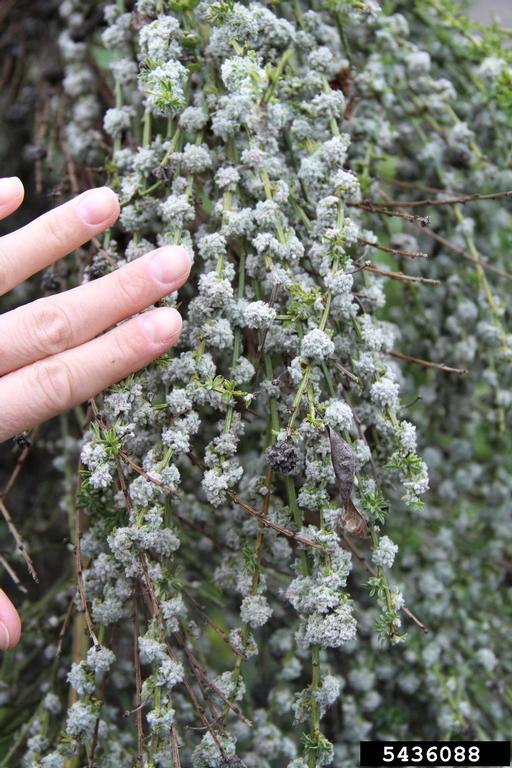
Broom Gall Mite infestation. Photo by Eric Coombs, Oregon Department of Agriculture (link)
Scotch Broom grows more rapidly than most forest tree species and can prevent seedling growth by keeping them from getting sunlight. This is why you see big hillside areas dominated by Scotch Broom. This invasive plant species is prone to burning quickly during a wildfire and bringing the flame up to the forest canopy contributing to the frequency and intensity of the fire.
You can learn more about Scotch Broom here.
We can’t blame Scotch Broom for being such a resilient fighter and producer. Most invasive plants aren’t inherently bad, but they are very effective at doing what they do best. It’s not their fault they were introduced, but we can take action to help prevent their spread and now is the perfect time to start!
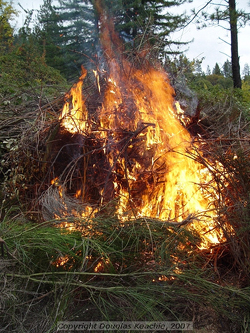
Scotch Broom burn pile. Photo by USDA Forestry (link)
So what can we do about it?
Different methods have been tried in many countries to get rid of Scotch Broom or lessen its impact. In British Columbia, Brush Hogs were used to twist off the above ground biomass, but they found that this method heavily impacted other nearby species. A study is being conducted in England, France, Australia, and New Zealand to see if insect biocontrol could be an option for control Scotch Broom populations. This has been previously studied in California with limited success, but might be neat as a future option upon further study. Grazing goats have been used in New Zealand as well, but it the problem with using goats is that they are not selective between invasive species and native species.
The most effective treatment for removal is a combination of cutting and burning the Scotch Broom. Studies have shown that when saw cutting (removing the above-ground portions of the shrub) is completed at the end of the summer drought period (August-October), the resprouting rate is less than 7%. However, when saw cutting is done at other times, the resprouting rate goes up to 40%-100%. So now is the time to get prepared to saw cut your scotch broom! Cutting the Scotch Broom now will allow enough time for the cut shrubs to dry before the controlled burn season where the cut shrubs should be burned. While this is the best method to get rid of the Scotch Broom for now, continued monitoring of the site is necessary to remove the seedlings from the dispersed seedback.
Sierra Streams Institutes is proactively researching different methods to mitigate Scotch Broom in our area. We are currently working with The Nevada City Rancheria Nisenan Forestry Crew and First Rain Land Stewardship Services on an ongoing study comparing cut-and-pile, cut-and-remove, and burning to look at which method reduces re-growth the most. Students from Nevada City School of the Arts are collecting data on pre and post treatment density and growth, and SSI is collecting data on burn temperature and severity to look at how best to manage monocultures/heavy invasions.
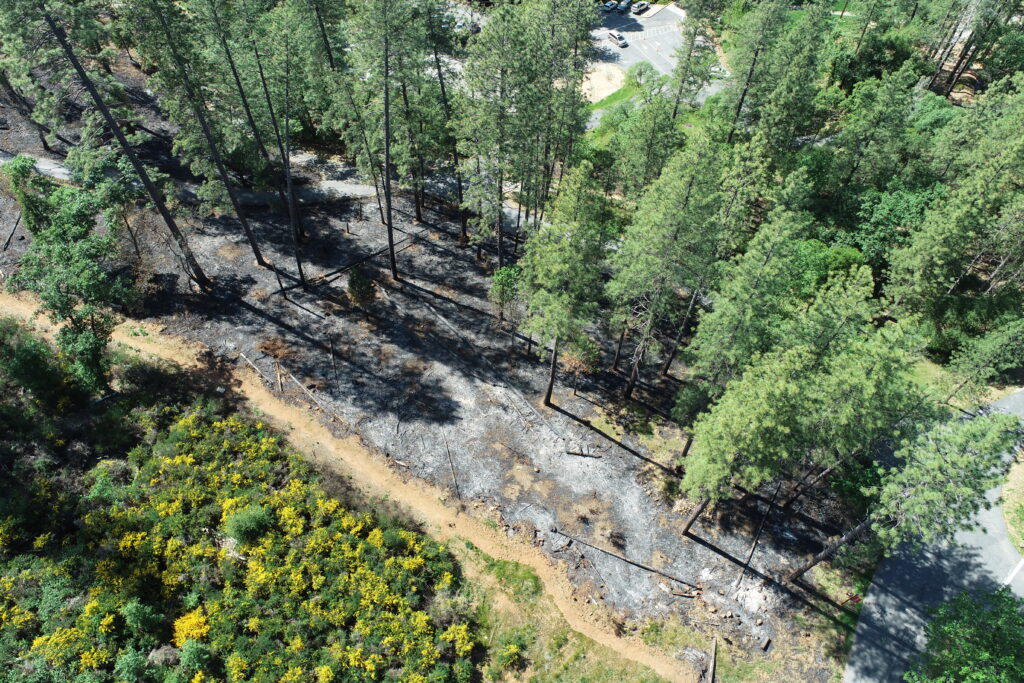
Drone footage of a post burn site at Nevada City School of the Arts (Kocin Pakan). Note the unburned Scotch Broom on the lower left of the photo.
To learn more and keep up to date on how you can help decrease fire severity in our area. Please check out our Resource Toolkit for Land Management in Western Nevada County.