
Reflecting our holistic restoration philosophy and tailored approach to each restoration project, the Restoration Program weaves together the collective expertise of its staff, melding restoration ecology, forest and fire ecology, water quality, hydrology, as well as other disciplines, to maximize effectiveness and increase scientific understanding of each restoration project.
The History and Practice of Restoration
For time immemorial, indigenous people managed ecosystems by employing sustainable restoration practices that balanced human needs and enhanced biodiversity. The practice of modern restoration ecology began in the early 1900s. At that time, people such as renowned visionary conservationist Aldo Leopold began promoting restoration, taking a landscape-level approach to land management to improve the health of land and water, plants, and animals, for future generations.
In the latter half of the twentieth century, restoration gained momentum and developed into an established science and practice. It has since grown to include a wide variety of ecological restoration activities that range from large-scale projects such as dam removal and watershed-level restoration, to smaller scale, such as invasive species removal efforts (i.e. Himalayan blackberries and Scotch broome). Recognized as an opportunity to test ecological understanding, restoration can enhance our understanding of complex dynamics, revealing gaps in our understanding of ecology, and identifying areas requiring additional study.
Restoration is shifting away from attempts to return to a historical baseline, and toward anticipating and adapting to projected environmental changes, emphasizing assessing and working with existing conditions, and then restoring system function, resulting in self-sustaining systems that foster biodiversity and include community participation. The future of restoration ecology requires an adaptive, collaborative, science-based approach to support resilient ecosystems capable of withstanding future uncertainties.
Let’s take a look at our current restoration projects.
Current SSI Restoration Projects
Post Dam Removal Restoration on Beale Air Force Base
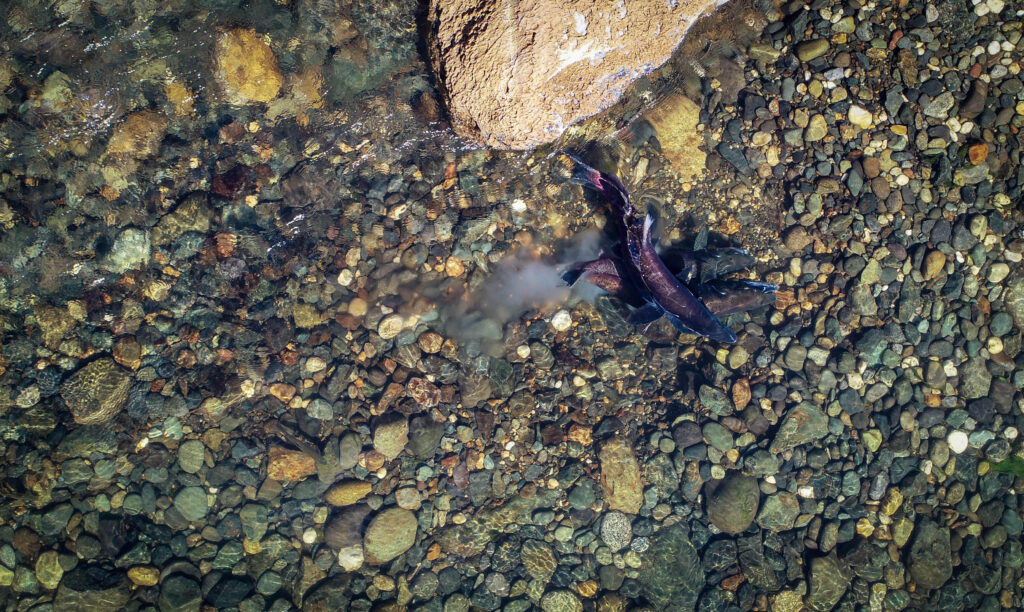
SSI’s flagship project entails post-dam removal restoration on Dry Creek to improve critical habitat for migratory fish travelling to and from the Pacific Ocean. The 2020 dam removal on Dry Creek within Beale Air Force Base restored fish passage and returned access to six miles of historic salmonid spawning habitat, benefiting fall-run Chinook salmon and federally threatened Central Valley steelhead. Following the dam removal, salmon returned to the creek for the first time in 80 years!
Since 2022, SSI’s ongoing restoration work at this site includes planting native plants, armoring stream banks to address erosion, eDNA analysis to detect salmonid presence, invasive plant species removal, water quality monitoring, vegetation monitoring, regular water flow measurements, and ongoing wildlife camera trapping.
Gravel Augmentation on Dry Creek in Spenceville Wildlife Area
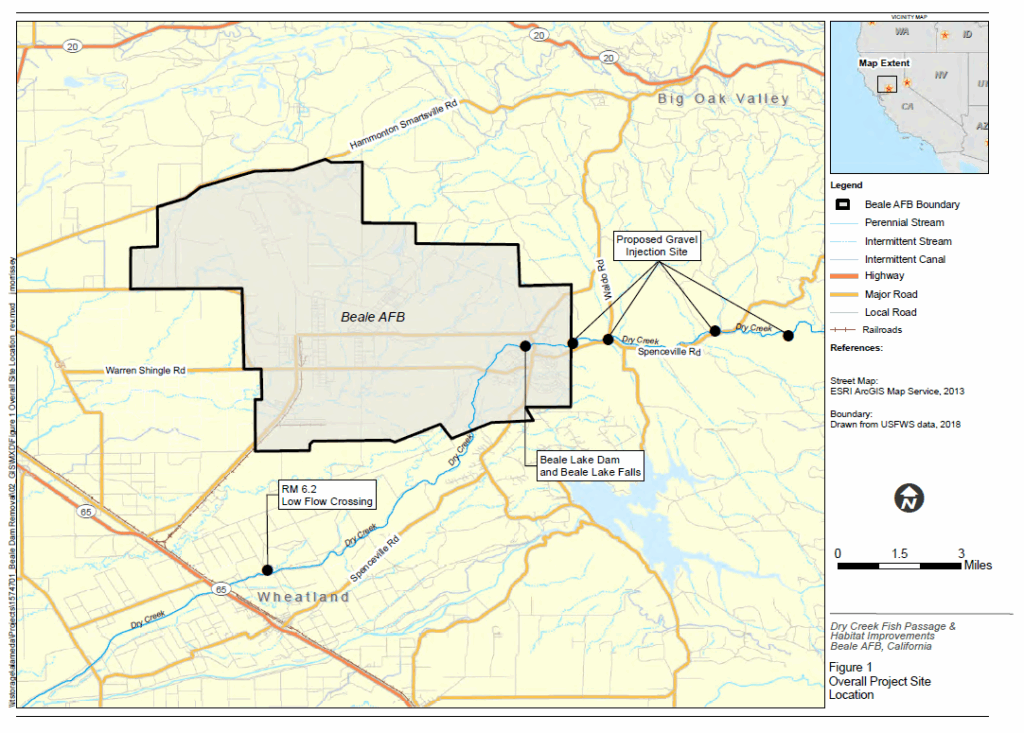
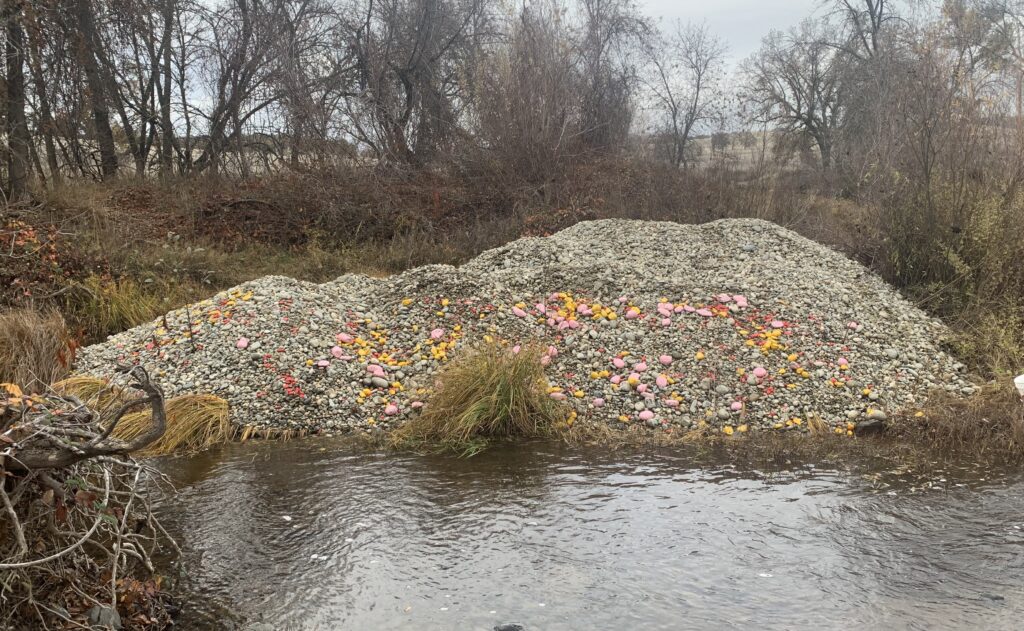
To further improve fish spawning habitat for salmon and steelhead on Dry Creek, SSI is preparing for a gravel augmentation project this fall within Spenceville State Wildlife Area. Up to 2,000 tons of spawning gravel will be brought in and strategically placed in multiple locations. Dry Creek’s seasonally high flows will mobilize and distribute the gravel material within the creek channel to enhance fish nesting habitat required for egg deposition.
Barrier Removal on Dry Creek
SSI is continuing to work toward removing a significant fish passage barrier on Dry Creek, called a low flow crossing. While it is still in the project implementation planning phase, surveys and assessments conducted by US Fish and Wildlife Service in 2016 identified this structure as hampering migratory fish passage. Removing this impediment will provide improved upstream access for spawning salmon and steelhead.
Sierra Foothills Forest Resilience Project—Jones Bar
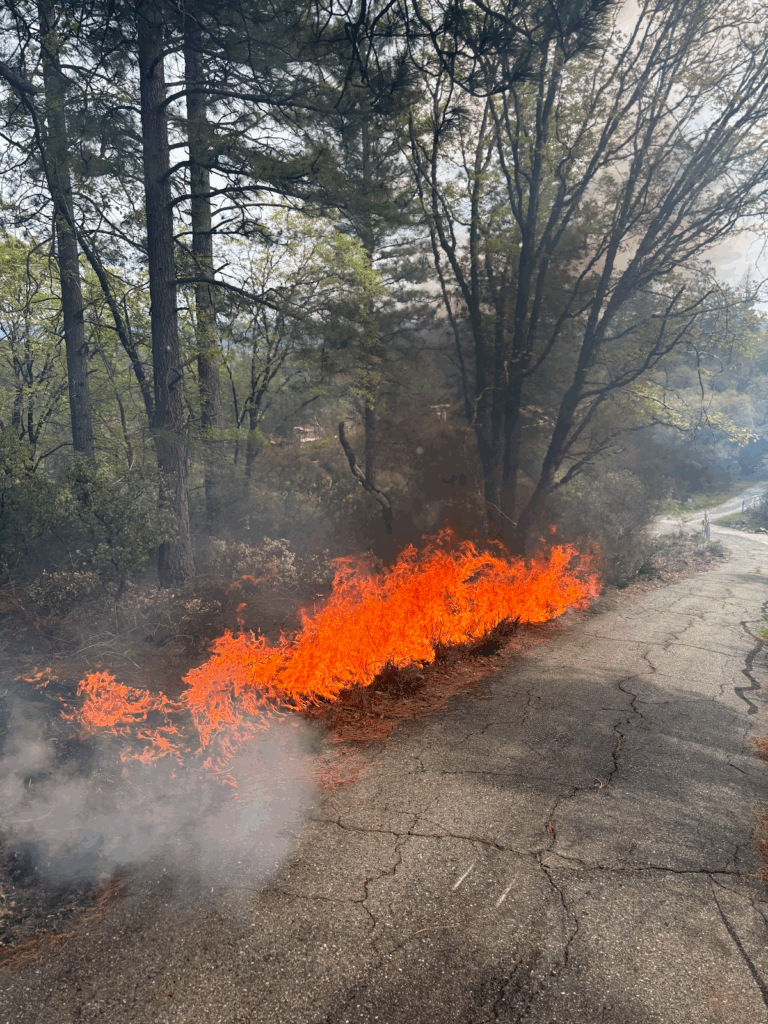
The Sierra Foothills Forest Resilience Project employs a landscape-scale approach across property lines to responsibly decrease the fuel load, improve forest health, and increase habitat diversity in the Jones Bar Firewise Community, located 5 miles west of Nevada City. In fall 2023, after consulting with landowners and inventorying the forest to develop Forest Management Plans, boots hit the ground at no cost to landowners on private, BLM, and some outdoor school land with the goal to treat 625 acres by 2028 to limit the risk of catastrophic wildfire and further enable landowners to maintain this land.
This partnership with CA Wildlife Conservation Board and Nevada County OES has grown to include local contractor work on BLM lands (untouched and overgrown since the 49er fire of 1988), Nevada City School of the Arts, Shady Creek Outdoor School, and Yulića (previously Woolman School, which has since been returned to the Nevada City Rancheria Nisenan Tribe and CHIRP). These collaborations have allowed the project to flourish, using adaptive management approaches to plant trees in the Pleasant and Jones Fire scars, get good fire back on the ground with demonstration burns, provide the community with a Resource Toolkit for Landscape-Scale Management, and involve children in researching Scotch Broom removal strategies.
Hart Fen
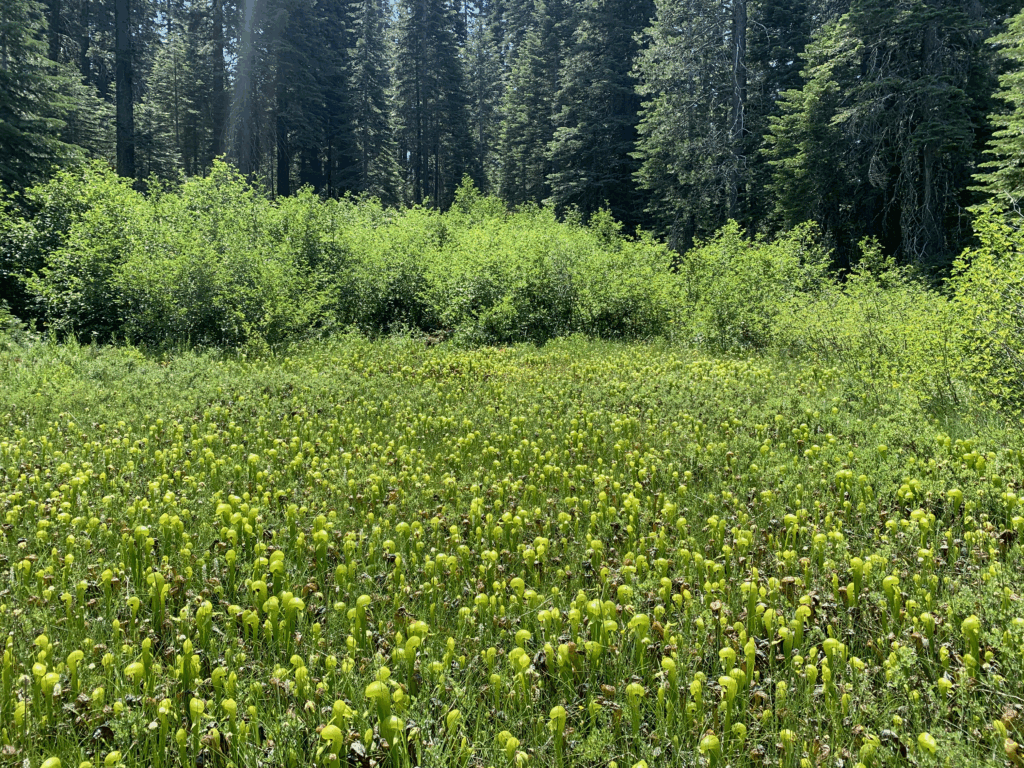
In partnership with Bear Yuba Land Trust, Sierra Streams plays a supporting role in the restoration and monitoring of a ten acre conservation easement known as Hart Preserve. This unique property is home to the southernmost population of California Pitcher Plant (Darlingtonia californica) thanks to the nearby spring, feeding the area with cold water all year round. This type of habitat, known as a fen, is rare in California and sensitive to disturbance.
Dry Creek Nature Trail on Beale Air Force Base
An important piece of SSI’s Restoration Philosophy involves work aimed to restore human relationship and connection with nature. The nearly complete Dry Creek Nature Trail traverses blue oak woodland as well as Dry Creek’s riparian (streamside) corridor and will include interpretive signage along its length.

I think it is wonderful, all the restoration that you all are doing. I think it is important to mention that Dry Creek is tributary to Bear River, and that Bear River also supports salmon habitat. In fact, lower Bear River is indeed the pathway for the salmon to enter Dry Creek.