

You have already heard us say this in a recent blog post, but here we will say it again: science and expertise are under attack. That is not an alarmist statement, and it is probably one that you all agree with or have at least heard whispers about. Dismantling of trusted panels of experts in medical science, gutting of regulations based on standardized definitions and decades of data, and even complete removal of data generated through decades of government-funded research on climate change from governmental websites all represent direct attacks on freedom of information and sharing of ideas and evidence used to understand problems of universal importance. Make no mistake; data and science are inherently apolitical, and unbiased. What a society does with that data and scientific information lay within the realm of government and political choice.
In these interesting times of politicization of science, we’ve decided we can’t sit idly by, taking a quiet backseat to public discourse as we often do at SSI, but instead speak up against what we see as the erosion of public understanding and trust in science. However, instead of making a claim or stating a position (other than this introduction), we’ve decided to simply discuss what science is and is not, and point to the need to continue to educate ourselves and each other about the scientific process. It is only through understanding, self-reflection, humility, and continued study that we all truly trust ourselves to gauge the treatment of science and scientific information at the federal level. And it is only through having these conversations and continuing to reflect on what science is and how we do it that we can better ourselves as a truly informed society. So below are a few principles of science, paired with caveats, that we all need to continue to remind ourselves of if we are to truly feel empowered as community members. The following points will be released over a series of blog posts in the coming months, but we’ll go through the list one by one:
- Science is changing your mind (but knowing when there is or isn’t enough evidence to do so)
- Science is “built on the shoulder of giants” (but can be done by anyone, as long as “first principles” are adhered to)
- “Correlation doesn’t equal causation” (but can if the “mechanism” makes sense)
- Science doesn’t make decisions or tell you how to live your life, it only provides information
- Science is a process, not an institution (but has an established process by which ideas are shared and agreed upon)
- Science is humility (but not always in the direction people think)
- Science is uncertainty (but this uncertainty is based in understanding of what you can and can’t know)
Science is changing your mind (but knowing when there is or isn’t enough evidence to do so)
Eggs are good for you.
But then they’re bad for you.
But then they’re good for you.
Who do I believe?! If scientists can’t even agree on if an egg is healthy for me, why should I trust scientists?!
This is a classic example of how public perceptions of science can be influenced by oversimplification of scientific studies in the media, and also speaking too definitively about a study’s outcome when the original study probably made no such definitive claims. Think of scientific studies as individual presentations to the scientific community as a whole about new evidence of a specific relationship or pattern, and the “field” of study presented in a research project as a court case that combines the principles of both civil and jury trials. In civil trials, the proponent of a claim is responsible for demonstrating a “preponderance of evidence” for their case, while in a jury trial, the goal is to convince the jury “beyond a reasonable doubt” of their case. Science is similar but in very specific ways; each paper or study is one piece of evidence for a particular phenomenon or question you are arguing, like a civil case, and the “jury of your peers” is other scientists, weighing the evidence, how you collected it, and if your conclusions make reasonable sense based on the evidence (data) you present. Once a field of research has numerous studies testing a particular idea and finding evidence for or against it, the evidence can all be viewed in aggregate, moving the field toward agreement on one particular idea and moving toward another. Answering a question or testing a phenomenon once is never sufficient in the sciences; we need a preponderance of evidence!
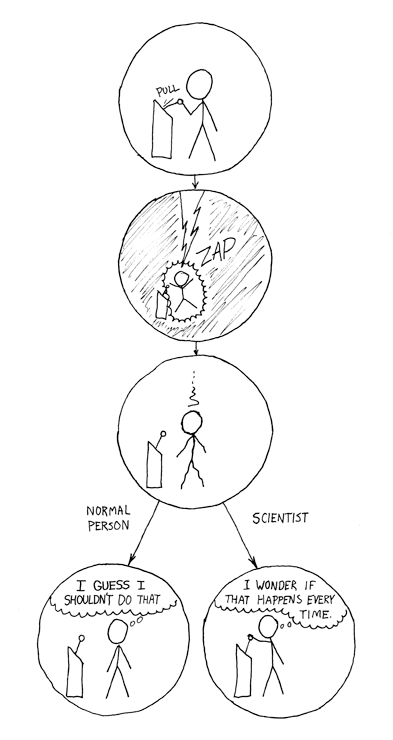
Masks during the early stages of the pandemic were an interesting case study in public perception of science. There was quite a bit of pushback, primarily in the United States, to masks after early studies found no significant evidence of their efficacy in reducing the spread of COVID-19. Follow up studies refuted this, with new, increasing amounts of evidence (as the pandemic grew and persists). As a scientist, when I see claims switch after reconsideration of new evidence, I get excited and lean more into the new conclusions, as long as a standard scientific process for updating evidence is followed (more on that in upcoming discussions of the peer review process), because that’s science! We found new information, and we were WRONG before, and we’re sharing that with you to make sure you have new evidence! The key caveat here is that not every study refuting a past one is enough to “change your mind”. Again…we need a preponderance of evidence. This is typically through multiple studies, “meta analyses” (analysis of multiple studies together to draw more sweeping conclusions), and testing old ideas with new methods, finding flaws, problems, or new questions.
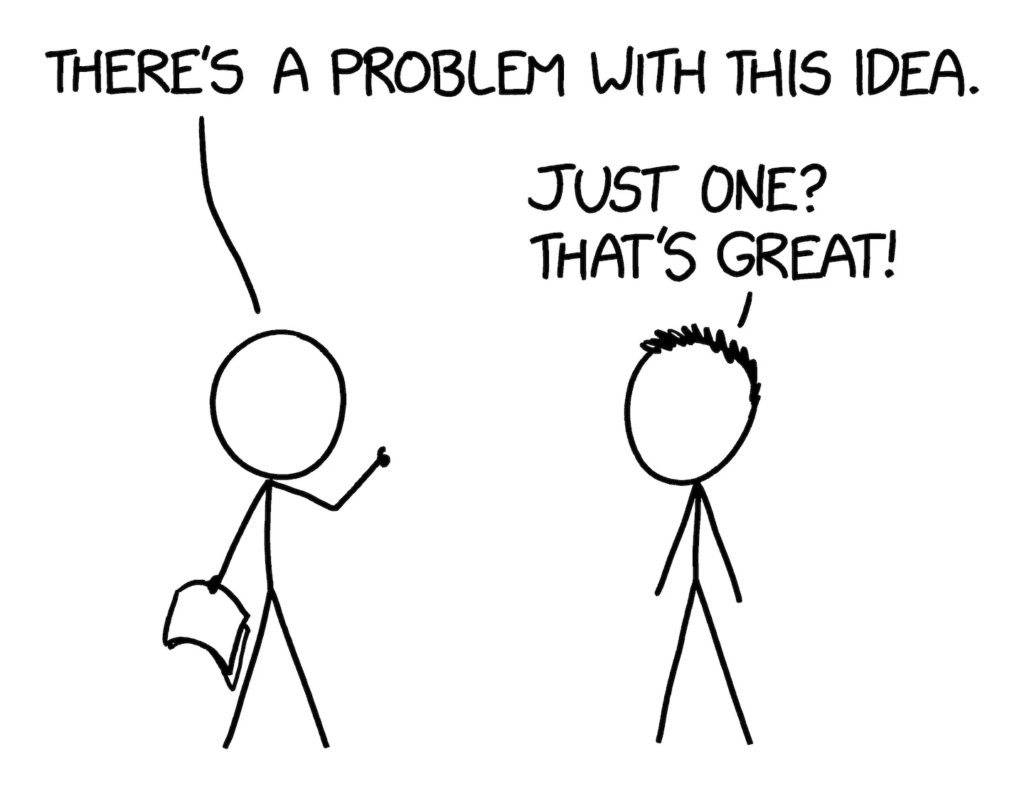
The primary difference between the scientific process and a jury trial is that we rarely can be convinced of something in the sciences “beyond a reasonable doubt”; that assumes that every potential possibility has been measured or tested! This is why you may have heard that in the sciences we have “hypotheses”, “predictions”, “theories”, and “laws”. This is where the “knowing when there is or isn’t enough evidence to do so” portion of the title of this principle comes from; is the information being presented a brand new result of a new hypothesis? Or is it yet another bit of evidence piling up for or against a particular conclusion? In order to even consider whether there is enough information, we should briefly review some terms and ideas in how information is tested and “agreed upon” in the sciences. Future discussions will outline the publication and peer review process, but for now, lets review terms many of you are probability familiar with:
Hypotheses are “educated guesses” about a relationship or outcome that are based on mechanism. This point (mechanism and what that means) will be touched on in later discussions, but boils down to “a guess that makes sense based on what is known about what I’m observing”. For example, a hypothesis might be “this species of bird is abundant in old forests because it prefers dense canopy at a particular height”.
A prediction, meanwhile, is usually quantitative and is just about the outcome (to extend the bird example above, “this species of bird will be higher in old growth forest than in younger forest”). Once enough examples of a particular hypothesis has been tested enough and evidence continues to build for it (or at lack of evidence against it), it may become a “theory”.
Theories are essentially examples of “things we’ve tested in every way we can think of, and broadly accept as true, but can’t reasonably say we have tested every single case because it is impossible to do so”. Examples are things like the theory of evolution or the theory or relativity—for all intents and purposes, they are “true”, but in the sciences we can’t legitimately say they are true because there may be a case we missed. Theories are rare, and are effectively the peak of most non-physics research ideas.
Finally, laws are reserved for the realm of physics at the moment; things like the laws of motion or the universal law of gravitation are considered fairly irrefutable at this point; these are ideas that are presumed to have been tested in every conceivable way and are accepted as “true”.
In order to “overturn” or call in to question ideas that have lots of evidence behind them, we need to consider if particular new information is anomalous (unusual or unexpected relative to all of the prior information) in a meaningful way, or due to some other source of error, interpretation, or even being a previously observed anomaly that makes sense and has been documented. We are all just building on prior information!
The main takeaway here, however, is that we hope you consider that science is inherently uncertain, and, at least to us, the most comforting words you can hear someone say when asked a technical question are “I don’t know, let me check the data and get back to you”.
So what does this all mean for you, and why should you invest in and support science now more than ever?
Remember that we are all scientists; we can all make observations, detect patterns, and ask questions. But also remember to be self-reflective, and consider what is already “known” or not about our questions, and what some of the “first principles” are that experts have spent decades or longer testing, comparing notes, and collaboratively confirming. Be curious, be humble, be willing to change your mind, but also be willing to learn from expertise (not just their word of mouth, but their work).
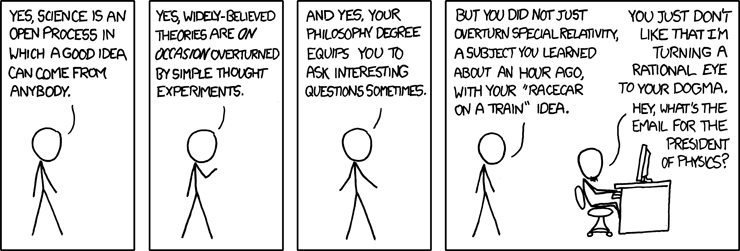
Science is a process that is for everyone, and it needs your understanding and support to thrive in these changing times. Support your local scientist. If it’s us, we are forever grateful, and you can find ways to support Sierra Streams Institute at the “Donate Now” button under “Get Involved”, but for now, we just hope you continue to learn, grow, and change your mind.
(All comic strips are borrowed from the illustrious XKCD)

This is a great essay on how science informs our certainty, or lack of that, through repeated investigations and summations of data from varied sources. In science, as in law, multiple lines of evidence are important for building a convincing case. This is exactly what has been going on with the continued regular updates on climate change done by the IPCC – the International Panel on Climate Change. In it’s 6th edition already, accumulating evidence has made it clear that warming of the planet is due to carbon dioxide emissions and that a whole host of impacts cascade from that. How certain can we be? Increasingly certain is the answer, and the IPCC has expressed this as levels of confidence or likelihood of having occurred and/or will continue to occur (e.g. sea level rise, extreme weather events, etc). Assessments specific to the State of California, now underway, to be released in our 5th assessment later this year, use the same kind of terminology to evaluate the weight of evidence approach to understanding climate change and its consequences. This should build public trust, not provide excuses for calling hoax to anything we don’t like.