
It’s another poster year for wildflowers in California, especially in places like Carrizo Plain National Monument, Death Valley, and Antelope Valley California Poppy Reserve. In all the excitement for these beautiful blooms it can be easy to overlook the exciting goings on among our other vegetal neighbors. If you’ve ever met me you know precisely what’s on my mind: moss.
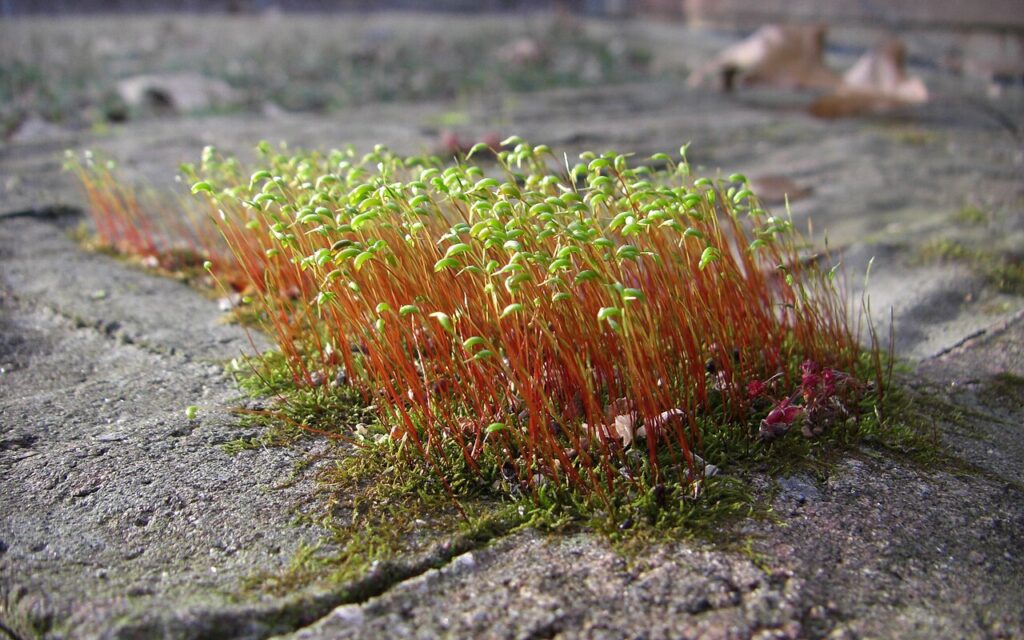
Mosses and their diminutive compatriots, liverworts and hornworts, have very different life cycles from flowers, shrubs, and trees, but one thing they have in common around the foothills is that spring is when they send up their “blooms.” These little plants, however, collectively called bryophytes, don’t actually bloom. Instead, they grow appendages called sporophytes. Whereas flowers are the site of fertilization, holding ovaries that become the fertilized seed from which the plant grows, the moss sporophyte is in fact the product of fertilization. Stated a bit more technically, the moss sporophyte has two chromosomes (2n, diploid) and is analogous to an adult human. The green, leafy stuff we recognize as a moss only has one chromosome (1n, haploid) and is analogous to an ova or sperm in the human life cycle. Could you imagine your child growing out of your head and staying attached forever?
When it rains, mosses release microscopic, motile sperm that swim around to fertilize adjacent moss shoots. Once fertilized the sporophyte begins growing from the tip of the moss shoot, often extending vertically centimeters higher than the moss clump. A capsule forms at the top of the sporophyte, and inside of this capsule meiotic division happens, taking fertilized, two-chromosmed cells and dividing them into single chromosmed things called spores.
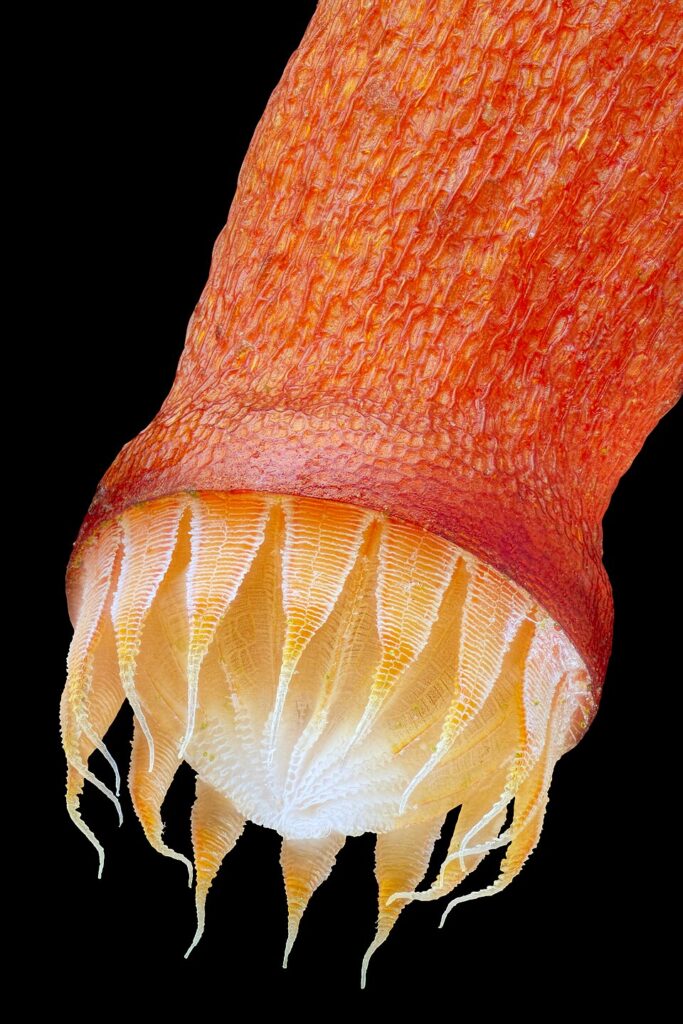
The sporophyte capsule, comping in a number of shapes and sizes, is equipped with some very cool (and beautiful) tools they use to control how and when spores are released. First there is a papery sheath of tissue called the calyptra, that wraps around the entire capsule. The calyptra is tissue shorn from the parent plant and helps regulate the internal moisture of the capsule as it develops. Dr. Jessica Budke at UT-Knoxville has conducted very interesting experiments trying to understand whether this constitutes competition or cooperation between parent and offspring. Next, there is a waxy cap that fits tightly to the capsule’s opening called the operculum. The operculum protects spores inside the capsule as they mature, and will fall, peel, or blow off as the capsule dries. Lastly is the peristome, composed of teeth that flex and bend according to ambient humidity and regulate spore release. Peristome teeth, as with all the other features I’ve mentioned, can vary wildly in size and shape from species to species. In the star mosses, Syntrichia, the peristome teeth reach into a fantastic spire, reminiscent of watching sugar be spun into cotton candy.
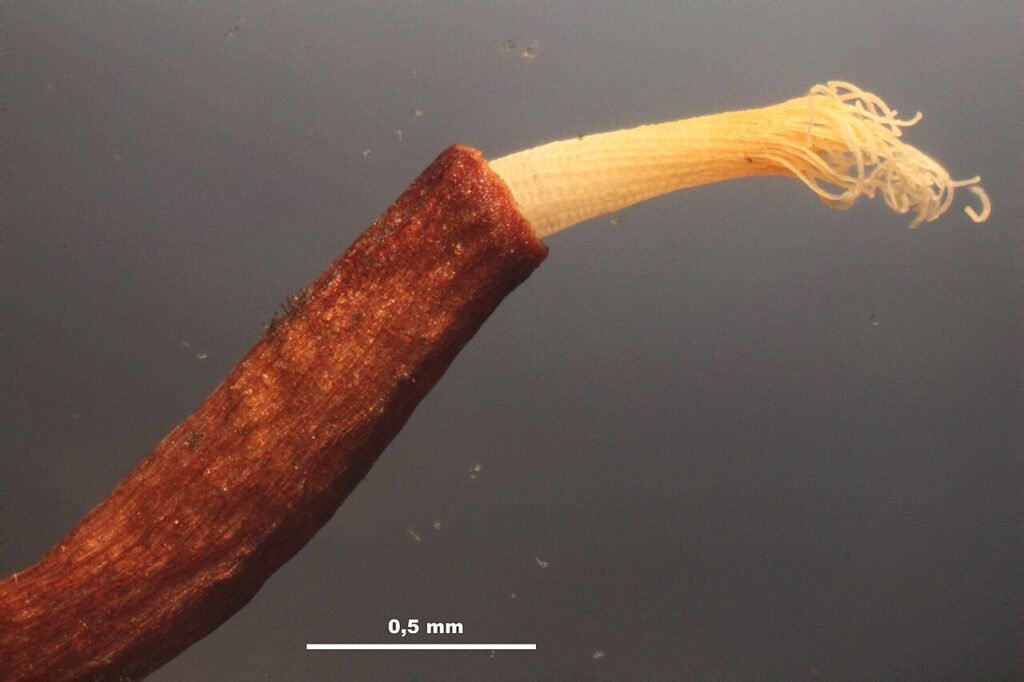
While mosses do not die back for the summer season, they do dry out. Their metabolism stops entirely but, remarkably, they do not die; they simply stop living (it is likely that most plants we are familiar with inherited and passed on the genes responsible for this trait in the form of seed dormancy). In this sense, sporophytes are the moss’ last hurrah for the growing season. As the wind blows and humidity changes with the sun’s rising and setting, the peristome teeth will open and close and spores will drift away on the wind.
Now that you know what to look for, I encourage you to take a moment to notice the mosses growing on trees and rocks around you. Can you find a sporophyte? Are there sporophytes? How far along in development are they? Can you find a calyptra, operculum, or peristome?
Additional Moss Resources
If you’re interested in learning more about mosses, peruse the resources listed below:
Gathering Moss by Robin Wall Kimmerer – An enchanting and approachable introduction to mosses.
https://www.robinwallkimmerer.com/books
“The Wonderful World of Bryophytes” – In Defense of Plants Podcast
https://www.indefenseofplants.com/podcast/2026/2/16/ep-566-the-wonderful-world-of-bryophytes
“Moss Traits and More” – In Defense of Plants Podcast
https://www.indefenseofplants.com/podcast/2026/2/23/qx5jwu1r9kzquy64oxjy1avkljpujh
“Introduction to Bryophytes” – Mini Workshop from UC Berkeley’s Jepson Herbarium (YouTube)