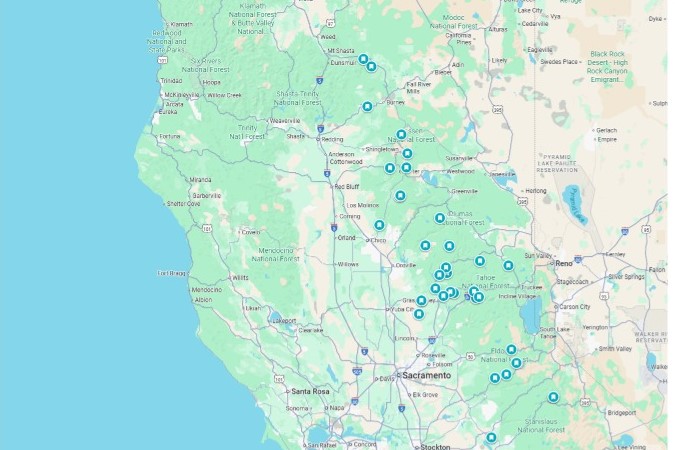
We’re well known for our river monitoring of Deer Creek and Bear River, but this year we’ve been busy. I am REAL busy expanding our monitoring sites all over Northern California through the Delta Project. During the summers of 2025 and 2026, SSI is collecting both environmental data (water chemistry data as well as samples of organic matter, algae, and environmental DNA) and biological samples (benthic macroinvertebrates, a.k.a “BMI”, which are larval-stage aquatic insects) in a suite of freshwater stream sites across the Northern Sierra. Our primary goal in this project is to use and expand on existing historical datasets for these Sierra Nevada headwaters sites, ultimately using this data to construct models that will help us understand the varied impacts climate change will have on our diverse mountain stream environments.
Map of the monitoring sites for the Delta Project.
It has been a wild summer so far with all the surveys we have been participating in, and wanted to share some of our highlights from the field.
Here’s a glimpse at our hardworking team’s day-to-day in the field!
A field crew member collecting coarse particulate organic matter (a.k.a. “CPOM”) from a creek bed. Organic matter is composed of leaves, fine woody debris, and other plant detritus that act as carbon inputs into the creek. Organic matter is an important indicator of overall stream health, as it is one of several primary food sources for many species of benthic insects. Gathering samples of organic matter allows us to quantify the availability of nutrients and resources to benthic communities. Photo credit: Mali Valerio, 2025
Two volunteers and a crew lead measuring dissolved oxygen levels in Oregon Creek. Oxygen in the water is produced by turbulence (more rapid, fast-moving streams will capture more oxygen from the air) and also by the respiration processes of aquatic plants. Just like us, stream insects and fish also require oxygen to breathe. Measuring oxygen in the water tells us about the habitability of the stream. Photo credit: Mali Valerio, 2025
A close-up of algae processing in the field. Algae is scraped from rocks collected off of the creek floor, homogenized with water, then passed through a fine paper filter. Water samples and filtered samples are then analyzed back at the lab to determine chlorophyll content and mass of algae per unit surface area. Algae is an important indicator of creek health. On one hand, it can be an important food source for many species of aquatic insects, and on the other hand, too much algae can indicate a disproportionate influx of nutrients into the creek (mainly nitrogen and phosphorus). This often occurs due to agricultural runoff and human activity, and it can lead to a process called eutrophication, which is when an increase in algae-friendly nutrients leads to an overabundance of algae. When algae takes over, it will outcompete other native plants, and when it dies and undergoes bacterial decomposition, algae depletes oxygen from the water. This process creates an inhospitable environment for most native aquatic species, including plants, insects, and fish. Photo credit: Mali Valerio, 2025
A newly-emerged dragonfly at Slate Creek. Photo credit: Mali Valerio, 2025
Emerald green waters at the Middle Fork Yuba River at Tyler Foote Crossing. A beautiful site, albeit tricky to access! Photo credit: Jessica Herrmann, 2025
A transect tape snakes its way down Bear River, near the Spenceville Swimming Hole. We use transect tapes to measure a 100-meter section of each creek site, and we collect all of our data within this established reach. A reach is like a snapshot of the overall creek ecosystem at a given site. Photo credit: Jessica Herrmann, 2025
Dave Herbst demonstrating how to install a pressure transducer at Shady Creek. We use pressure transducers at selected sites to measure changes in the depth of water within a cross-section of a channel. This data enables us to estimate flow, i.e. the volume of water passing through a channel per unit time. Photo credit: Jessica Herrmann, 2025
Sign Up for Our Newsletter
Keep up with the latest from Sierra Streams Institute!