First Rain Land Stewardship Services, part of First Rain Farms, is an exciting grassroots land stewardship group that SSI has been partnering with for forest health work as part of our Wildlife Conservation Board-funded Sierra Foothill Forest Climate Resilience Project. First Rain provides fuel reduction crews, prescribed burn services, and grazing all as a part of an integrative approach to forest health that acknowledges the integral component fire plays in Sierra Nevada forest evolutionary and cultural history. Here at SSI, we embrace community science, grassroots land management, and integrating scientific understanding—including changing conditions and when the “old model” isn’t working—in how we approach environmental health. By following state-certification processes like the California State-Certified Prescribed Fire Burn Boss process (CARx), Tim Van Wagner and First Rain are part of a “changing of the guard” bringing new, necessary approaches to prescribed fire and fuel reduction into the forefront of the land management process in the Sierra. See our interview with Tim Van Wagner below:
Can you tell us a bit about your background and how First Rain got started?
First Rain Land Stewardship Services emerged out of First Rain Farm, a certified organic farm my wife, Kat and I have owned and operated since 2012. Our farm is located just two miles outside of Nevada City, in the Lake Vera/Purdon neighborhood. Since 2012 we have been developing a system of farming that relies minimally on outside fertility inputs, and have been able to achieve this through the integration of livestock into our land management approach and by developing a compost-generation system where we “bed” the goats down in our barn at night to capture the manure and urine in a deep bedding. Having been the steward of our 37 acres of land since 2012, there were many many years of observing and coming to understand our land. Using managed grazing with goats, we were able to transform our land from an overgrown, blackberry dominated landscape, to an open and ecologically diverse place with unique riparian features, open fields, and forested areas.
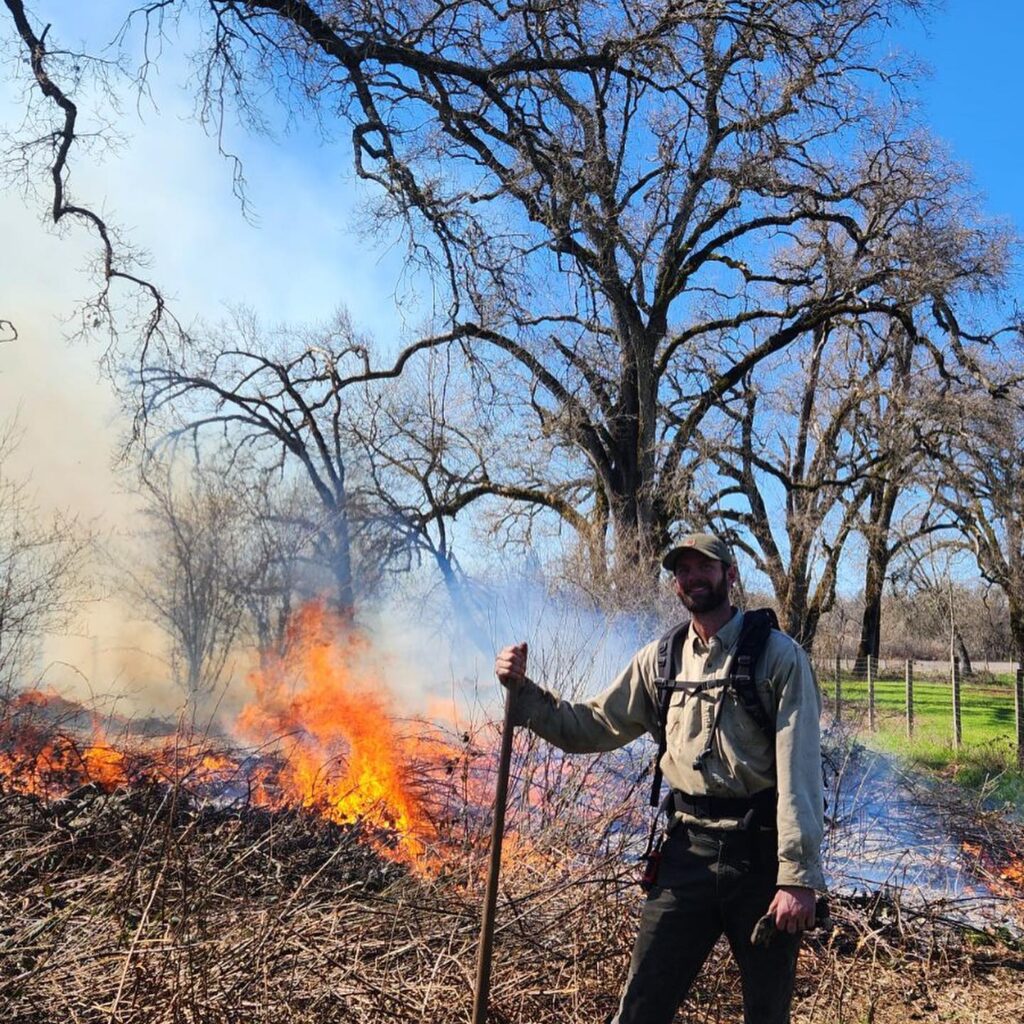
After the Camp Fire (2018), we were compelled to try and make a difference beyond our own property, for our community. We “exported” our grazing services to surrounding properties and grew our goat herd. As the herd continued to engage with new pieces of land, one common feature always remained – the substantial build up of dead wood and forest litter. Around 2019, we “discovered” fire as an incredible land management tool. During the winter we were burning some piles and observed the fire creep away from the piles and enter some low blackberry brambles – the result was stunning. Areas that had been completely covered in a mat of bramble were instantly exposed, leaving behind a fine layer of ash and a fertile seed bed. Spring rains followed, and a flurry of new seeds germinated. This was an epiphany for us, and our lives were forever changed. We dove head first into understanding fire and ultimately became a state certified burn boss in prescribed fire (CARx). We now offer our grazing and prescribed fire services as a means to improve the fire resilience of landscapes, and as a means to improve the ecosystem function overall.
What’s up with these goats and why are they so important to land stewardship?
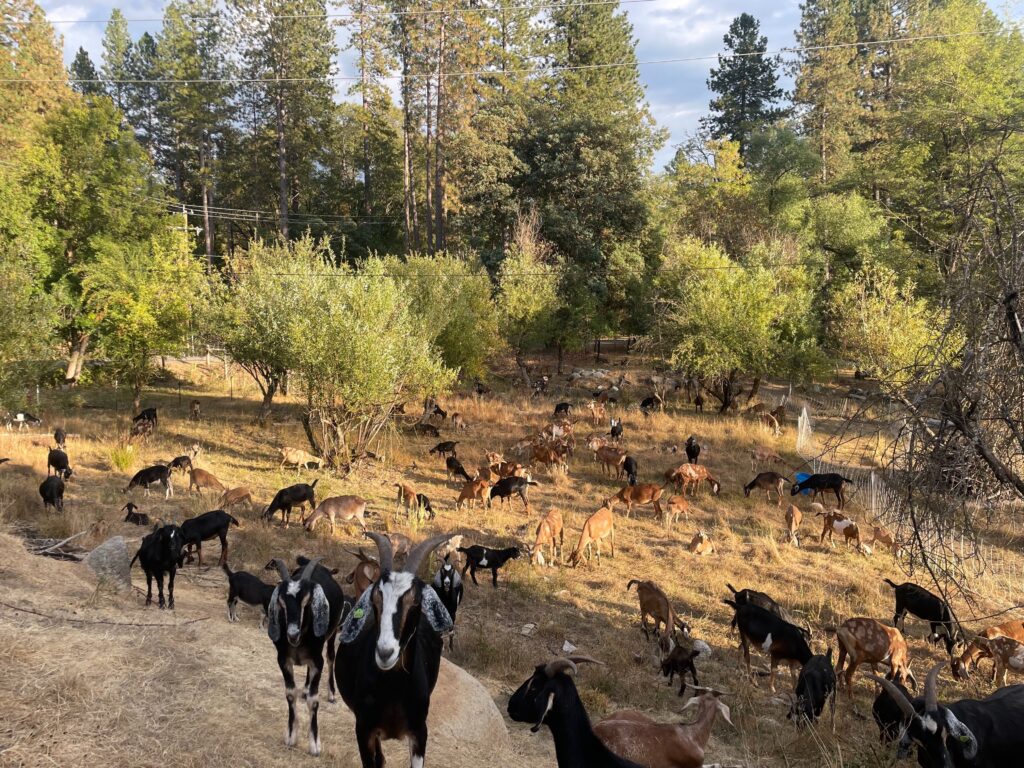
For us, our goats became a way to measure the abundance and health of a landscape. Goats are very similar to deer – they are both browsers and enjoy many of the same foods. When we place our herd in a grazing area, called a paddock, our goats immediately offer us feedback on the landscape. Are the goats content with the food they have available or are they hungry immediately? What we have come to understand about this “fire deprived” landscape, is that a critical component of “beneficial disturbance” has no longer been allowed to function. A beneficial disturbance is some action on the landscape that creates opportunity for the renewal of that system and plant or animal life.
In the absence of regular fire returning to the landscape, certain plant species have been left unchecked. Those species are able to continue their proliferation despite the lack of fire. Typically, these are plant species that spread through rhizome (think poison oak and kitkitdizzi) or species that have large seeds with the ability to push through a mass of litter on the forest floor (think oak and conifer). Over time, these dominant species crown out or shade out other species that aren’t getting the right disturbance opportunity to renew themselves (think small seeded grasses and forbes like wildflowers). Grazing with a herd of goats is another type of beneficial disturbance of the landscape that helps to “level the playing field”, creating opportunity for a wide range of plant species that would otherwise be out competed. While much of the attention to targeted grazing like this focuses on fuels reduction, which is certainly a big part of it, for us we really get excited when we see the overall landscape health improve. When we achieve a reduction in fuel through grazing, we are also starting a new process whereby we create opportunities on the landscape for plant species that are laying dormant, waiting for the right conditions.
What is your favorite part about your job and the services you provide?
My favorite part of my job is when I see the land respond in ways I had hoped it would, and when it shows me something new that I wasn’t aware of before. I think the biggest part of stewardship and being a steward is becoming a student of the land. There is an infinite amount of information to gather, and the system is so dynamic and beautiful it becomes a lifelong process of growing your wisdom. I think to do this you have to work to maintain a humble curiosity about the processes on the landscape, as well as working to discover the underlying cultural ideas we carry with us, many of which are falsely rooted in ideas of “wilderness” and the untouched landscape.
We know you are one of the only certified burn bosses in the area, can you tell us what that means and why it is so important?
I became a state certified burn boss because I wanted to become fully equipped to do this work for my community. I firmly believe that a piece of paper doesn’t make you an expert in your field, and that it is the experience under your belt that truly creates your abilities and informs your decision making process, however, there is something powerful about being deputized by the state to do something as important as bringing “good fire” back to the land. With the certification, I become eligible to enroll our Rx burn projects in the California state liability fund, which protects my business and clients in case there were damages as a result of our burn. We desperately need to increase the capacity of Rx burning in California, and this certification is attempting to create more fire practitioners and tackle this capacity issue.
Is there any project that you have worked on that stands out greater than the others and tell us why it stands out to you?
I feel especially connected to projects in my own neighborhood. Stewardship is about creating a relationship with the land and when you get to return to see the results of your work over and over again you not only learn more deeply the impacts of what you’ve done, but you develop an affinity for the land and a deep understanding for the process you are applying to the land and becoming a part of. Some of our larger and contiguous burns have been conducted down New Rome Rd., just off Lake Vera/Purdon Rd. Over two years we burned nearly 200 acres on the South Yuba River canyon rim, which is part of a strategic fuel break called the “Hoyt-Purdon Fuel Break”. Much of this terrain is very steep, with stunning views of the river. Knowing that we have contributed to creating a landscape that may be able to slow a wildfire and save out community feels very good.
How did you get connected with Sierra Streams Institute?
I think that our use of methods that truly align with the natural forces of the landscape (fire, ruminant grazing) made us a perfect fit for the numerous projects planned by Sierra Streams Institute. Fuels reduction with an eye towards landscape and ecosystem health – what could be better? Sierra Streams has a unique way of applying a scientific framework to understanding the needs of the landscape, but also staying in the “student” mindset and continuing to learn more about how to approach work here to support the diversity of flora and fauna and the protection of our community. We too find ourselves constantly in the “student” mindset, applying what we think is correct, but also adjusting our future treatments based on observation from previous treatment outcomes.
Can you tell us about your experience working with Sierra Streams Institute?
We have truly been honored to work with Sierra Streams Institute. There is a deep trust required between an organization and a contract business that is needed to complete the work effectively and efficiently, and to work with the broader community constituency around their specific needs and desires. We see ourselves as an extension of Sierra Streams – we are our own business, but we know that in a very real way we are representing Sierra Streams to the community. We have been impressed with the level of organization and logistical planning required to carry a project as large as the Sierra Foothills Forest Climate Resiliency project.
You have worked with SSI and other organizations on lots of prescribed fire in the region. Why do you think using fire as a tool in our area is so important, and what would you like the community to understand about prescribed fire?
We are coming out of an era that attempted an impossible feat – the removal of fire from the landscape. It is like saying we are getting too much rain, let’s keep the rain away from the land. There are consequences when we obstruct an important natural process from occurring. This fire suppression has been happening for long enough that there has been a cultural amnesia about the truth. We are literally having to educate people on the fact that, yes, fire has been a regular force on this landscape, literally forever. Sometimes it feels similar to telling people that yes, the food you eat is important to maintaining your health, and wellbeing. We are grappling with how to reintegrate fire into a landscape that has dramatically changed because of its lack of fire. The crux of the matter is that without using fire as a land management tool, we will continue to experience catastrophic wildfires. I think the main takeaway I’d like people to understand is that fire is simply an amazing tool at our disposal. For many people, fire is grouped into one main category – and that is wildfire, but there are many different types of fire, so reframing our relationship to fire is important. I wish everybody could be on a Rx fire at least once, perhaps as a requirement of graduating high school! It is truly a life changing event, and highly empowering.
We have heard you are currently working with Yuba Watershed Institute and Bureau of Land Management to do some targeted grazing on Round Mountain. Can you tell us about that project?
First Rain Farm and Land Stewardship Services is partnering with the Yuba Watershed Institute and the Bureau of Land Management on a unique targeted grazing project on Round Mountain Recreation Area, just outside of Nevada City, CA.
Beginning in October 2025, we will be using our goat herd with over 200 animals to maintain a strategically important fuel break for the community. A shaded fuel break is an area that has a mature over-story canopy, but has an open and accessible understory. Typically, shaded fuel breaks are created along strategically important access roads and provide opportunities for fire containment in the event of a wildfire.
Within the Round Mountain Recreation Area, a shaded fuel break was created many years ago along Hudson Road, Rock Creek Road, and Moonlight Trail. This is an important area to have a shaded fuel break because it exists between the South Yuba River canyon and the Cement Hill, Lake Vera/Purdon and North Bloomfield communities, as well as Nevada City proper. Over the years, due to a lack of maintenance, brush and understory vegetation has once again encroached upon the road and diminished the potential effectiveness of this wildfire control feature.
In partnering with the Yuba Watershed Institute and the Bureau of Land Management, we will be providing the regular maintenance that a shaded fuel break desperately needs to remain effective. Our herd of goats is the perfect fit for such a task because of their browsing nature – not only do they enjoy the diverse grasses, but they also eat the brush that, if left long enough, will eventually crowd the understory and create fire containment issues.
Unfortunately, there is currently no direct funding for this project and sadly, many shaded fuel breaks suffer the same lack of maintenance funding. Because our farm is located within this area, we feel especially called to implore our goat herd to help protect our community in this way. We are calling on our community to help fund these efforts.
Thank you First Rain Land Stewardship Services!
We at SSI are excited about the important work First Rain is doing, and our continued partnership, now entering its third year, with them on fuel reduction, fire, and grazing work in the region, including upcoming fuel reduction and burns as part of the Sierra Foothill Forest Climate Resilience Project. If you are able, please click the link above to support the important work being done on Round Mountain.