
Written By Christian Noack
As we enter safe burning conditions (CalFire lifted its residential burn suspension on Oct 17th), now is the time to ensure you are taking advantage of the more comfortable weather and practicing good stewardship of our land by creating burn piles! Not only does safely burning the forest fuels on your land get rid of 150 years of fuels built up from misguided forest management and fire suppression, but it also brings people together to enjoy each other and appreciate the place we’ve decided to reside in.
While of course, we can leave the larger diameter fuels as logs to heat our homes, burn piles consume the smaller yard waste (less than ~6 inches in diameter) on-site without too much hauling, filling up green bins, or a trip to the dump. It’s also one step in the right direction to get fire back on the ground in this ecosystem that has evolved with fire. Keeping the idea in mind that much of these forests (pre-western settlers) experienced fire on a “Fire Return Interval” of every 15-25 years, the idea is to artificially match the natural mosaic on the landscape that a mixed-severity fire would create until we eventually get to the point where our forests are safe enough to allow fire to do what it does best without risking human infrastructure. This means spending time on your land to prioritize removing ladder fuels and breaking up the continuity of fuels so that, if a wildfire comes, it doesn’t build in intensity and rise to the canopy of our trees, but has this natural ebb and flow that is easier for firefighters to get a handle on and doesn’t devastate the landscape like these high-intensity catastrophic fires we’ve been seen across the state.
Some quick things to note to ensure you have a successful pile burn this season:
Make sure your pile has had enough time to cure before you burn it. Plan ahead! While some dead plant matter (manzanita especially) will burn hot immediately with no problem at all, a lot of what should go into these is alive until you come with the chainsaw. Recently killed trees and shrubs have a lot of moisture, so plan ahead to leave them out to dry for at least a few months to ensure you get complete consumption, don’t smoke out your neighbors, or waste a ton of “juice” to get it lit.
Make sure each pile has a mixture of fuel sizes. Like starting a fire in your fireplace or campfire, you won’t have a good time starting a log without kindling. The same goes for piles. Keep some smaller fuels in the middle and at the bottom to allow your ignition source to build intensity, heat up and dry out the fuels around it, and grow to consume the entire pile. Taking a tip from one of our local contractors, First Rain Land Stewardship Services, you can use waxy produce boxes to help light piles (keeps flame going long enough to dry out surrounding fuels and grow).
Keep pile burning in-mind when creating your burn piles. Make sure there is adequate spacing around piles. CalFire requires 10 feet between residual live trees and shrubs around piles, but with how much how manzanita we have in the Sierra’s, that isn’t always enough. Fuel type and quantity need to come to mind when you are cutting open areas in dense fuels. Make sure you have open canopy above and cleared mineral soil around your piles to keep your piles from spreading or creeping (unless that is your goal with a mosaic burn, but we’ll leave that for a later post). While some scorching is inevitable, you want to limit canopy scorching as much as possible. If there is too much fuel to fit in your selected space, you can always leave a windrow or decked pile to load the burn pile as it dies down to keep your flame heights low and fit into smaller burning locations.
Avoid rocks or stumps when building piles. Building a pile on, or next to, a rock or stump makes it difficult to ensure piles are completely out when you walk away. Stumps can smolder and burn down through the root system and flare up and start wildfires up to weeks later when conditions may become drier. Rocky areas make ringing the pile down to mineral soil difficult and they often have roots growing underneath that can spread underground smolders as well.
Ignition types. While not everyone has access to a drip torch, you can use the same mixture of gas/diesel ~40/60% ratio that firefighters use when backburning. Take caution to never pour over open flame. A propane tank with the proper torch can also be a high-powered way to ensure piles get lit fast. If you’ve made sure your piles are expertly constructed, dry and you are feeling like skipping to advanced mode, you can eliminate adding diesel to the soil or using expensive fuel by utilizing more traditional methods like lighting cedar sapwood or carrying embers, or even just lighting with a lighter.
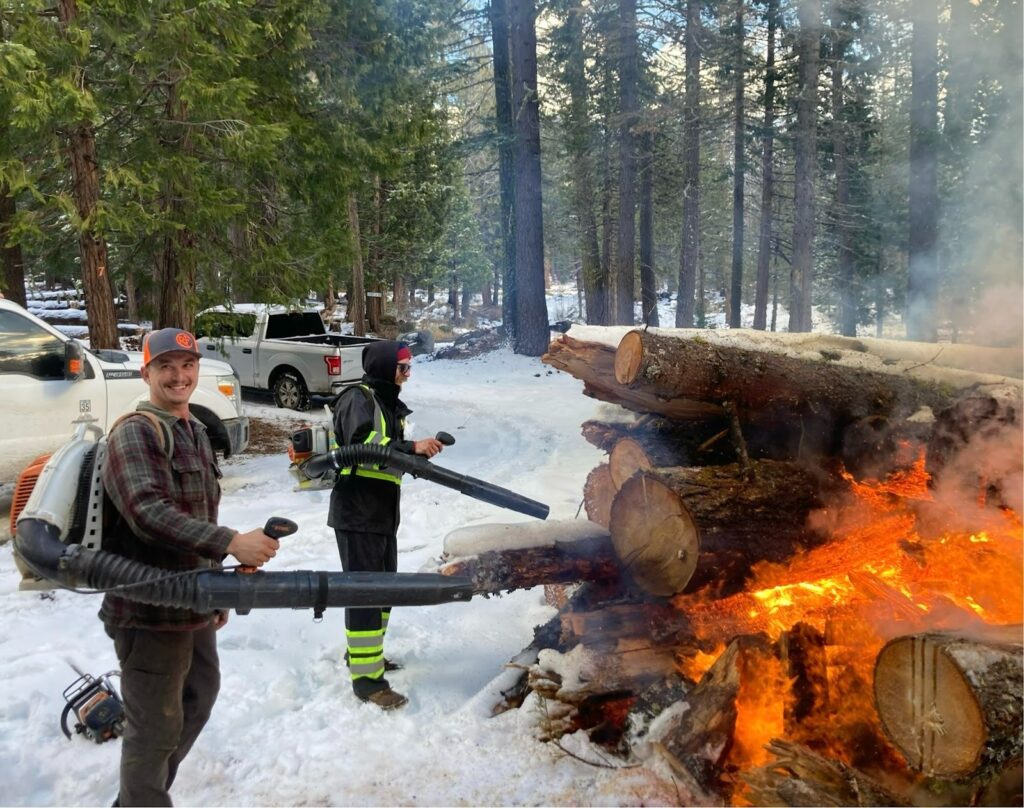
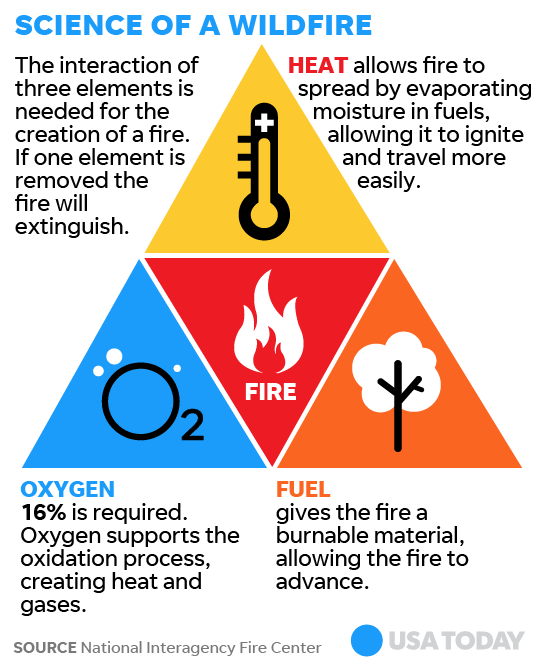
Keep the Fire Triangle in mind. The more you understand fire, the safer and more successful we can be in making and controlling our own. Make sure you aren’t packing these piles too densely with larger fuels. If you are having real trouble getting some larger fuels lit, a leaf blower can be a great way to add some oxygen to the equation.
Try to stack up tall piles instead of low and wide. There are three kinds of heat transfer properties at work in a pile burn (convection, radiation, and conduction). With flames, rising convective heat is more efficient than radiant heat, so ensure the flames can climb.
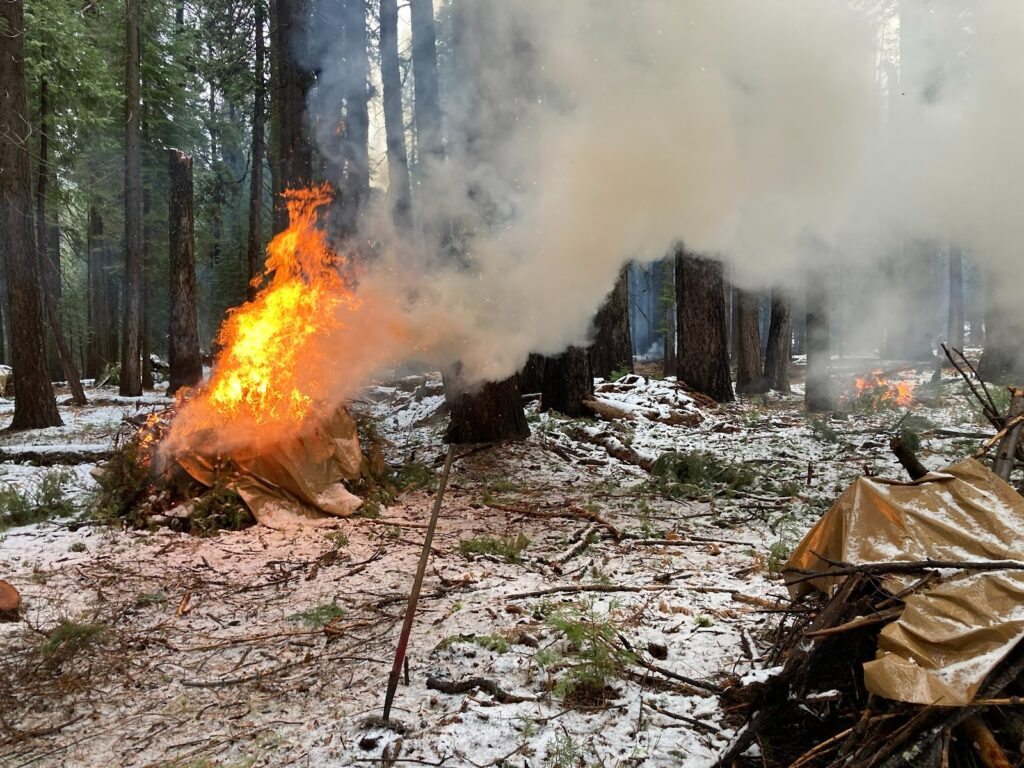
Keep your piles dry. Use what you have on hand to cover your piles to ensure rain or snow doesn’t make it difficult to light when the time comes. Wax paper is nice since you don’t have to remove and store over winter like with plastic tarps (you also won’t create a bunch of plastic bits of litter in your forest). Place the covering over the pile while you are making it so that you can put some heavy fuels on top to ensure it doesn’t blow away.
Push in your piles. While you can let the fire do most of the hard work, keep pushing in the burning material (once it’s died down and cool enough to do so) to ensure you get full consumption to avoid unburned sticks in a ring around the burned center that were too wet/not pushed in to burn completely. Making “bone piles” of logs lying straight next to each other is a good way to ensure oxygen can access the fuels while allowing the conductive heat to ensure the logs burn down to ash.
Have burn parties! Like these forests, humans evolved with fire too! Nothing makes the mind wander and relaxes the soul like standing around and watching embers of a fire. It helps, knowing you are doing your part to make next summer a little less stressful. Make sure food and potentially a hot beverage are available to ensure your friendly volunteers know they are appreciated participants.
Wanna learn more? Check out our Resource Toolkit for Landscape-Scale Management in Western Nevada County!