Field Season Recap!
Now that we head into fall, it’s a perfect time to reflect on our 2026 monitoring field season here ...

The short answer to this questions is yes, but lets dive into what type of glaciers we have, where we can find them and what the future looks like for Sierra Nevada glaciers. Glaciers respond to variations in climate through change in their size and thus are important visual indicators of climate change.
A glacier is a large slow moving river of ice found on land. When we are talking about glaciers in the Sierra, we aren’t talking about the large ice sheets, or continental glaciers, one would typically find in the polar regions, like in Antarctica. Those glaciers cover more than 50,000 square kilometers (31,069 square miles) and over 99% of the land mass. The glaciers we have in the Sierra Nevada are mountain glaciers and are typically found in mountain cirques, which are essentially amphitheater-like valleys formed from glacier erosion. The glaciers in the Sierra Nevada are found on the North and Northeast facing cirques which get more shade than sunlight. The glaciers in the Sierra are not typical glaciers as they are smaller and closer to the equator than most glaciers.
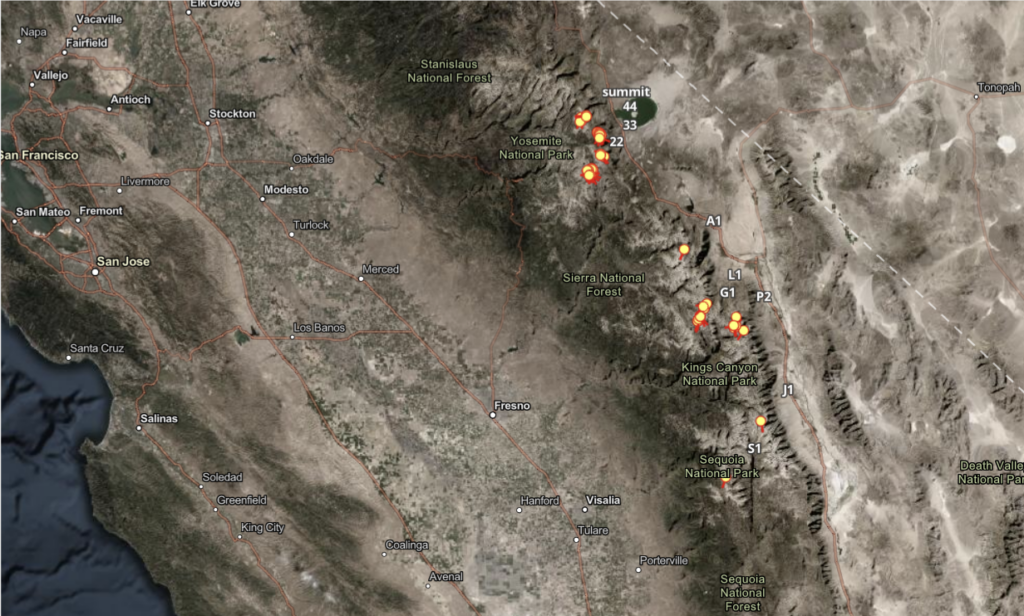
The majority of glaciers in the Sierra Nevada can be found in Yosemite National Park, Kings Canyon National Park, and Sequoia National Park. These glaciers are found above 10,00 ft of elevation and are found in the highest peaks of these National Parks. Takes take a closer look at a few of these glaciers:
Mount Lyell is the highest peak in Yosemite National Park at 13,114′ and along with its neighbor Mount Maclure (12,880′) host two Sierra Nevada Glaciers. The Lyell Glacier is estimated to be roughly 0.5 miles long while the Maclure Glacier is estimated to be roughly 0.20 miles and both of these glaciers are actively retreating. Some argue that these glaciers have lost any movement and could be considered an ice field.
If you have hopes in seeing these glaciers, expect a long out and back trek, 28.8 miles long, with an elevation gain of 8,180′. This route should only be considered if you have experience in dealing with variable weather conditions, and specialty equipment including crampons and an ice axe. In peak conditions, you have the option of hiking directly up the glacier to the summit of Mount Lyell, and are rewarded with superb mountain and glacier views.
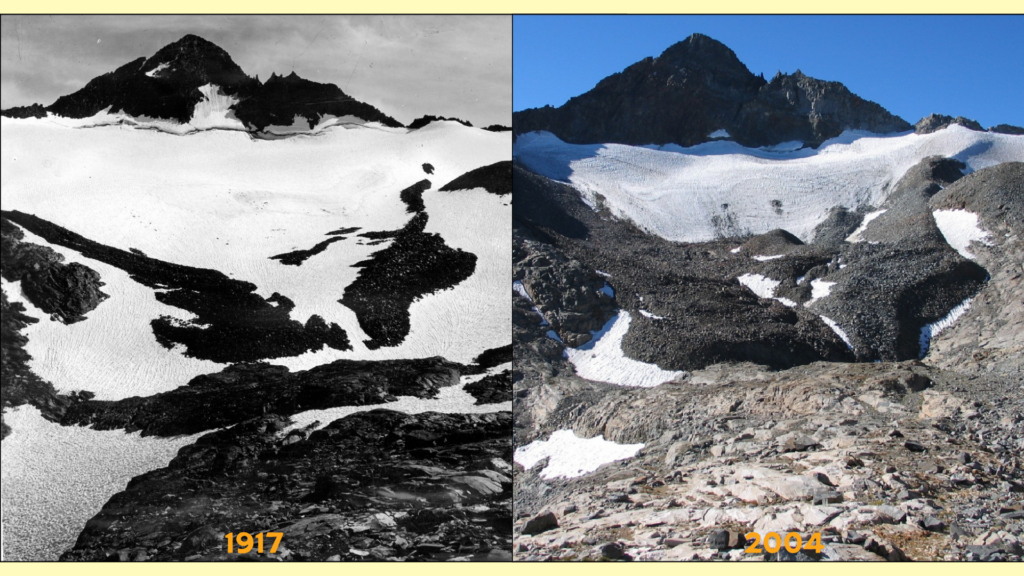
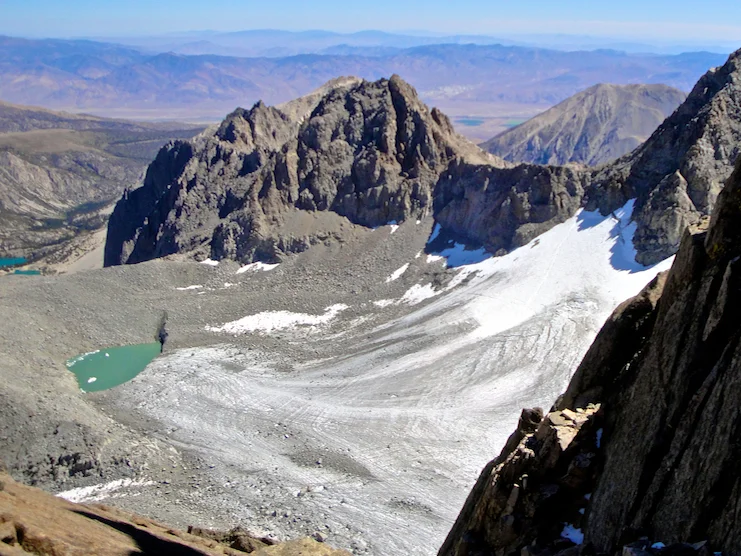
The Palisades Glacier is just below the North Palisade peak (14,242ft), the third highest peak in the Sierra Nevada, in the John Muir Wilderness and part of Kings Canyon National Park. The glacier is roughly 0.81 miles long and is a retreating glacier that moves at a rate of 20 feet per year. This glacier terminates in a proglacial lake, which was created by the damming or build up of a moraine. A moraine is an accumulation of debris left from a retreating glacier. The turquoise color comes from the glacial powder suspended in water.
While possible to see this glacier in person, it does require mountaineering knowledge including technical rock climbing. Some VOCs, volatile organic compounds, and traces of metals have been found in the Palisade Glacier, including: acetone, naphlathene, benzene, cadmium, chromium, and arsenic. These chemicals and metals are a result of a several things including human agriculture and pacific volcanic eruptions. The pesticides and ash particulates become airborne and get carried into the mountains with weather systems. When it snows over the glacier they contaminate the ice.
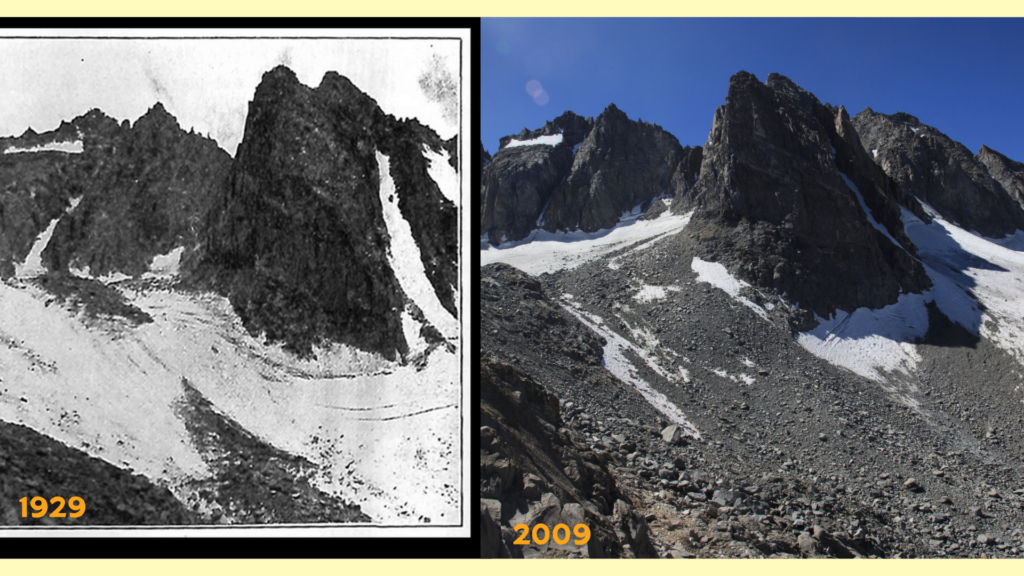
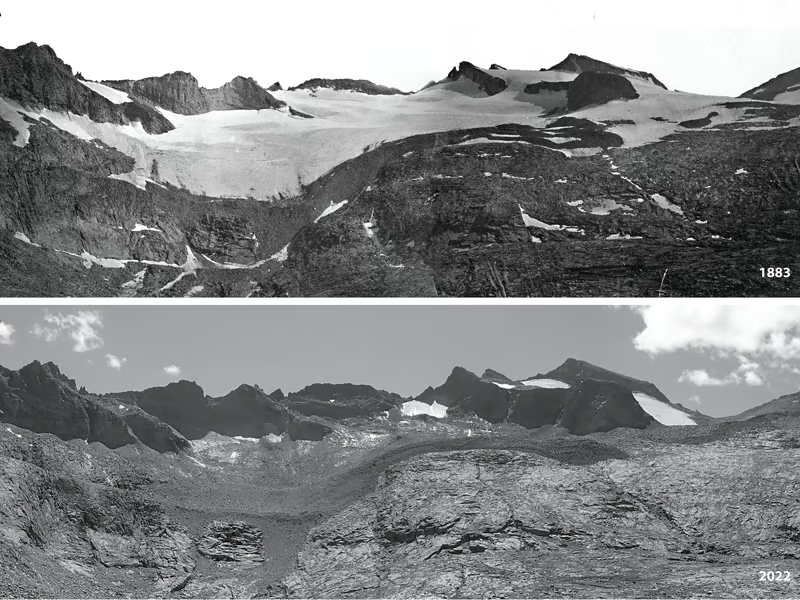
In an article published last fall, the authors showed glaciers in all of the western United States are projected to disappear by 2100. Although its not really news that the Sierra Nevada glaciers have been slowly disappearing, the timeline in which they are disappearing had been unknown until recently. Here you can see a video of the Lyell and Maclure glaciers retreat from 1883-2015:
Shrinking glaciers are visible symbols of climate change effecting freshwater storage, river runoff, and biodiversity and through studies show directly the connection between retreating glaciers and global greenhouse gas emissions. Currently, the outlook for glaciers in the Sierra Nevada is not a good one, see the table below for predictions around our largest retreating glaciers:
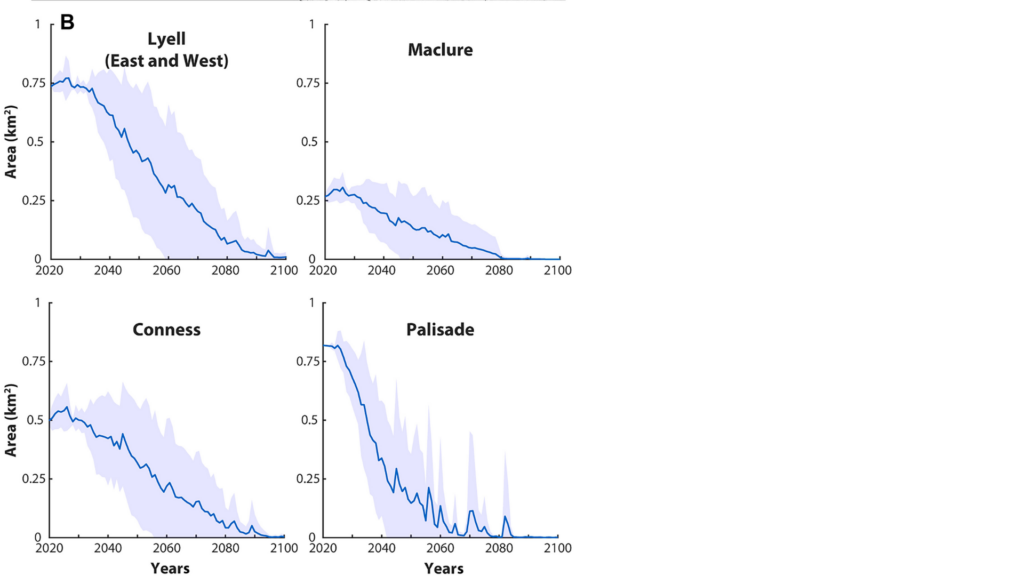
As you can see, the Palisade and Maclure glacier are expected to disappear by around 2085 and the Lyell and Conness glaciers around 2100. We encourage you to read the recent study about our Sierra Nevada glaciers and the how they they make these predictive models.











Dave Herbst says:
Great article and summary of the state of glaciers in the Sierra Nevada. Same story by and large for other glaciers across the globe. One little-known aspect of the cryosphere (the frozen world) being studied more recently are ROCK GLACIERS, which are glaciers that have been buried by rockfall or forming as permafrost with a protected matrix of rock at high elevations where melt water from above will freeze and accumulate as a body of ice. As these formations are protected from solar radiation they melt only very slowly and so provide a special habitat of cold water that persists at high elevations, forming a unique community of aquatic invertebrates and refuge for other animals and plants that would otherwise be lost as surface glaciers disappear. Stay tuned for another blog about the hundreds of rock glaciers known in the Sierra.