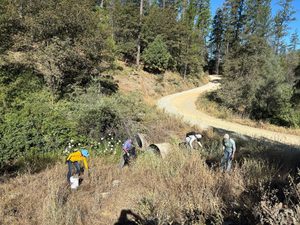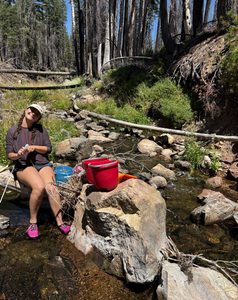
Field Season Recap!
Now that we head into fall, it’s a perfect time to reflect on our 2026 monitoring field season here ...

Originating at 4,800 feet in the Sierra Nevada foothills, Deer Creek winds its way through pine and fir forest, providing valuable habitat for fish and wildlife along the way. Travelling 34 miles from its source to join the Yuba River, Deer Creek is home to both native and non-native fish. Native fish species have naturally existed in a specific geographic area for generations without human intervention, while non-native fish species are introduced to areas outside their historical range.
Let’s take a look at fish detected in Sierra Streams Institute’s (SSI) past surveys, grouping them according to whether they are native to California or non-native!
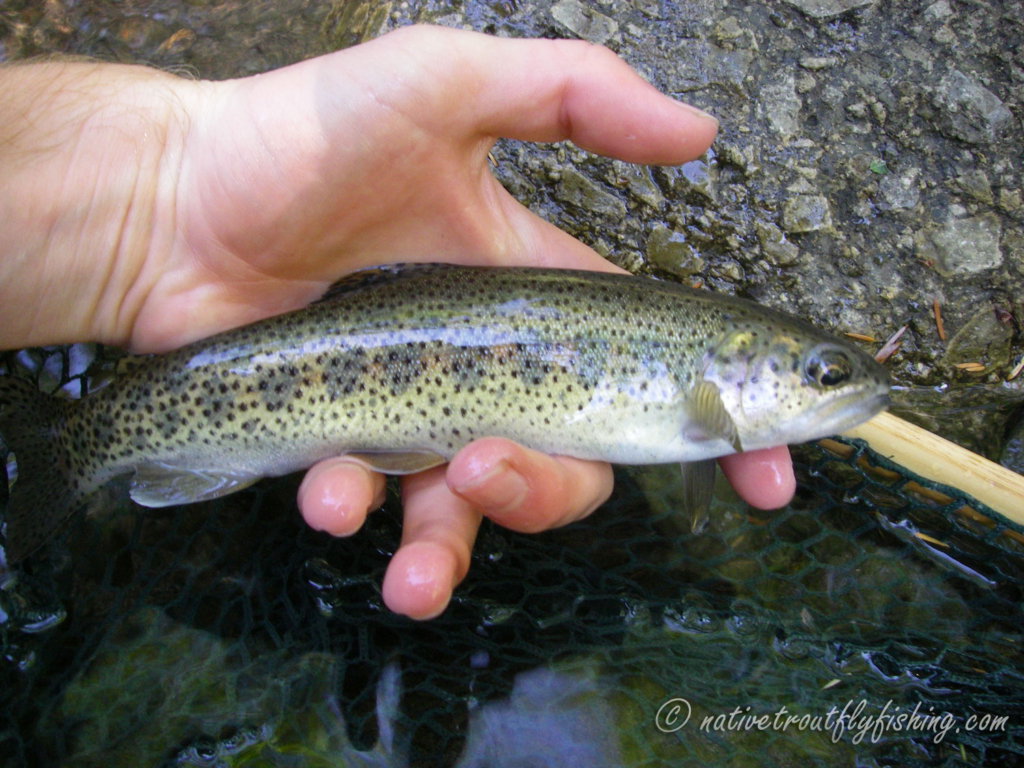
Deer Creek and its tributaries harbor self-sustaining wild fisheries, including a robust rainbow trout population. During dry months, flows are enhanced by irrigation water from the Nevada Irrigation District system, providing good conditions year-round for rainbow trout.
Resident (non-migratory) rainbow trout were originally found across California upstream of natural barriers, such as larger waterfalls, that migratory rainbow trout (aka steelhead) couldn’t pass. Over time, widespread rainbow trout introductions made these fish commonplace in streams providing suitable habitat, where they continue to reside behind natural or manmade barriers.
Highly adaptable to different environments, rainbow trout can exhibit a wide range of coloration, from dark olive on the back with a yellowish belly in small streams, while lake-dwelling fish often appear more silvery. Most have heavy, irregular spotting, with spots radiating in lines on the tail, and a white belly. The pink to deep red band on their sides inspired their name. Stream-resident rainbow trout averages 1–5 lbs (0.5 to 2.5 kg) and can grow to approximately 20 in (50 cm).
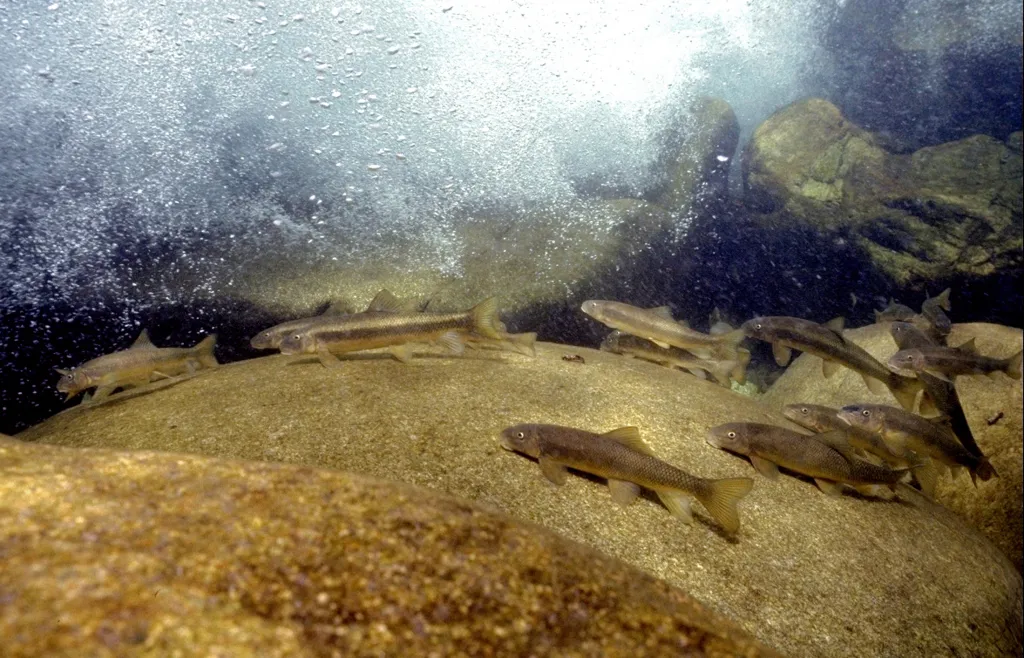
Another native fish found in Deer Creek, the Sacramento sucker is a bottom-dweller characterised, and named for, its feeding method. These fish feature horizontal mouths that are angled downward, allowing them to suction onto the bottom of the stream. Sacramento suckers consume a diverse diet that includes insect larvae, worms, fish eggs, and vegetation, thus are considered omnivorous (consuming animals and plants).
With adults growing up to 2 ft (60 cm) in length and weighing nearly 4 lbs (1.8 kg), these fish have a green or brown coloration with yellow bellies. Their long, streamlined bodies feature specialized fins that assist with navigation and maintain contact with substrate.
Serving as an important food source for Indigenous people, these fish were (and still are in some places) harvested year-round, and especially during spawning season when they are easily accessible. An important component of freshwater ecosystems, they serve as a food source for eagles, osprey, and carnivorous (meat-eating) river mammals such as otters and mink. Other fish species also benefit from Sacramento suckers, including Chinook salmon and rainbow trout, which consume both their eggs as well as larval fish.
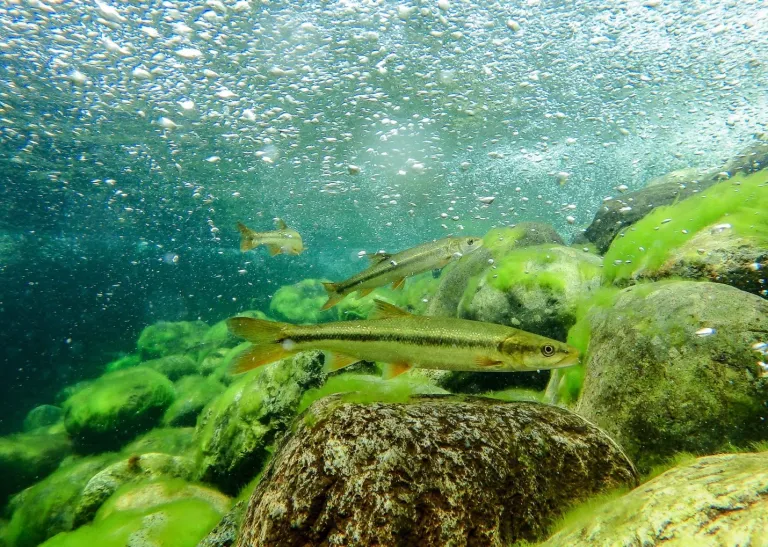
The Sacramento pikeminnow, a wide-ranging and abundant native California fish, also resides in Deer Creek. This fish is adapted to survive severe droughts, floods, and other natural disasters and to preying on other native fishes (Moyle 2002). Capable of growing to a large size, with adults reaching 2-3 ft (61-91 cm), the pikeminnow is a predatory fish that feeds on aquatic invertebrates when young, and crayfish, other fish, and amphibians when they reach a large adult size.
An interesting anatomical feature of this fish is the dagger-like teeth located in the throat, used to masticate prey. Sacramento pikeminnow plays a role in stream ecosystems, however in some locations it has earned a bad reputation for its impact on salmon populations. This is primarily in the case of areas where it has been successfully (and illegally) introduced such as the Eel River in Northern California and streams in Southern California.
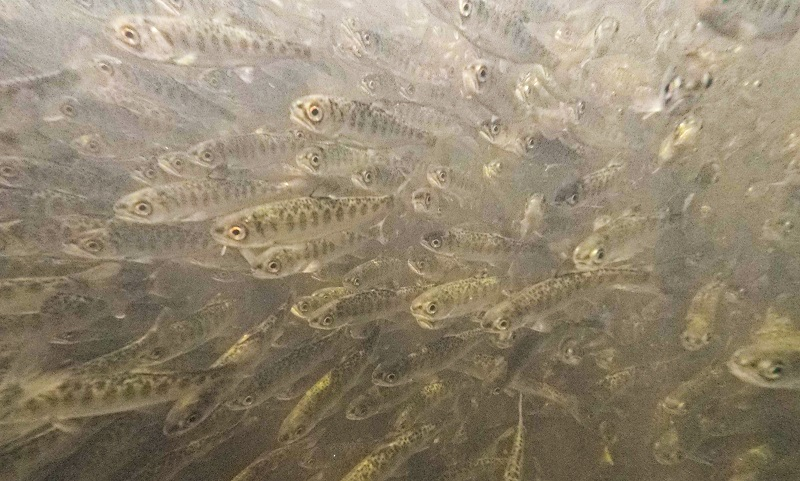
Deer Creek provides critical habitat for anadromous (migrating from freshwater to ocean and back) fish, including Chinook salmon, as it is the last Yuba River tributary before it meets the Sacramento Valley. Historical records indicate that salmon and steelhead were once present in Deer Creek and the Yuba River in large numbers (Yoshiyama et al., 1996), with the mouth of Deer Creek considered a “hotspot for biological productivity and salmon spawning” (Pasternack et al. June 2010).
SSI’s fish surveys detected fall-run Chinook salmon using lower Deer Creek for spawning grounds. Adult fall-run Chinook salmon migrate upstream in fall, through December, and sometimes into January, to spawn. Fall-run Chinook salmon contribute to large commercial and recreational ocean fisheries, and popular sport fisheries in the freshwater streams.
Chinook salmon have numerous small black spots on the back, dorsal fin, and both lobes of the tail in both sexes and can reach lengths of 1.5-2 ft (45-60 cm). Spawning adults are olive brown to dark maroon without streaking or blotches on the side. Males are often darker than females and develop a hooked jaw and slightly humped back during spawning. Their average weight is 19–22 lbs (9-10 kg), although the largest Chinook salmon (on record) taken in California was 85 lbs (38.6 kg)!
The general view held by California’s EuroAmerican settlers was that most native fishes (except salmon and trout) could easily be replaced by non-native fishes (Rypel et al. 2021). This devaluing of native species has often led to the promotion of preferred species, even sometimes non-native species, at the expense of diverse native ecosystems. This led to the establishment of about 50 non-native fish species across California, some of which reside here in Deer Creek!
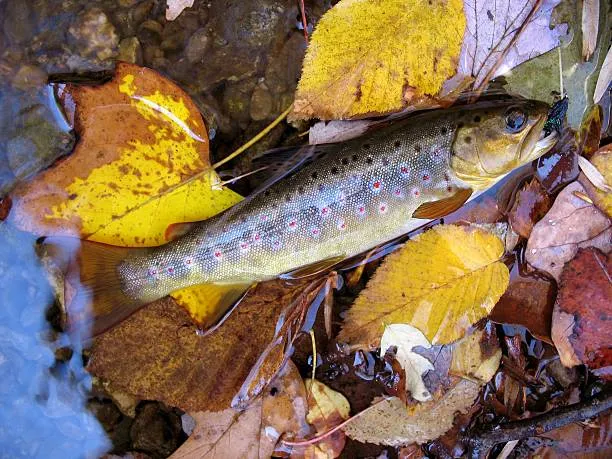
Native to Europe, North Africa, and western Asia, brown trout were introduced to California in 1893. Moved widely across the state, these fish are present in a high percentage of suitable waters, especially on the west and east sides of the Sierras, with water temperature an important factor limiting their distribution (preferred temperatures are 53-68 ℉/12-20ºC).
Coloration is usually dark to olive brown on the back, shading to yellow on the sides, and yellow or white on the belly. Brown trout have both red and black spots on their body, which are typically encircled with a pale halo. Larger rivers or reservoirs with naturally spawning populations in tributary streams can offer trophy size (>18 in/45 cm) brown trout fisheries!
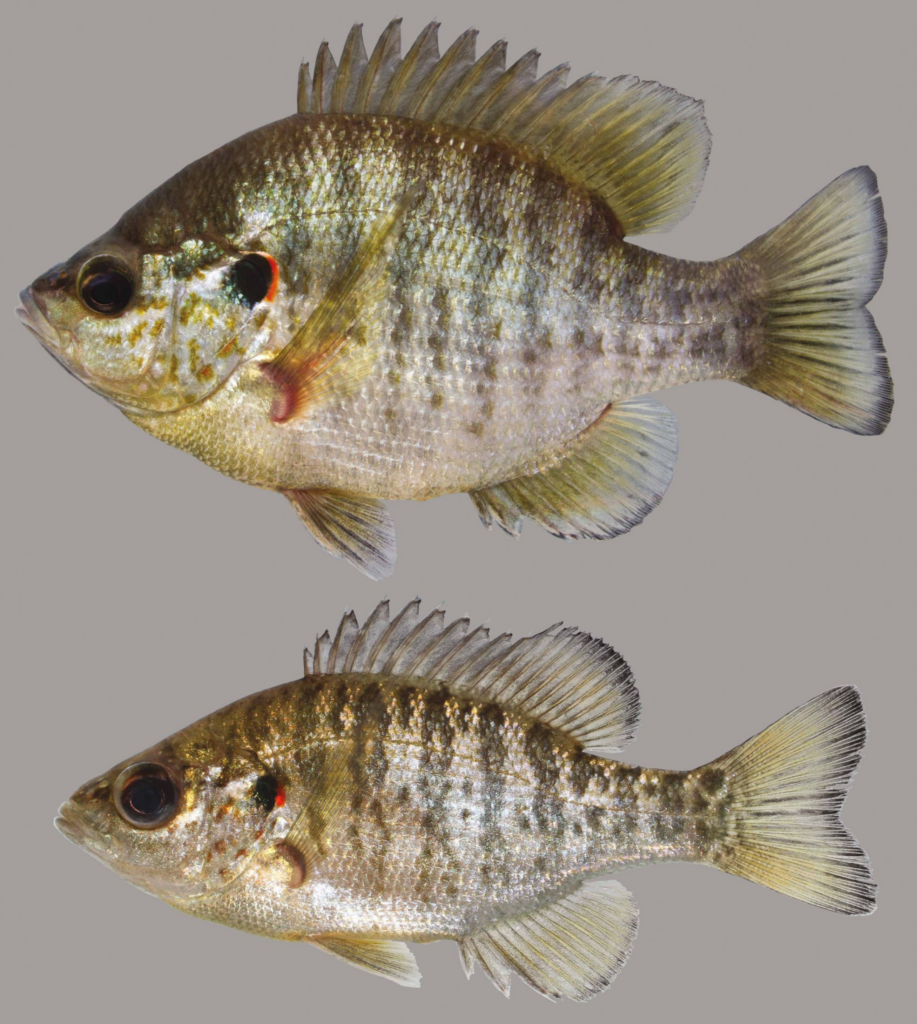
Redear sunfish are commonly found in ponds, lakes, and slow moving pools in streams, including Deer Creek! Native to waterways of the Southeastern United States, redear sunfish were introduced to California in the 1950s to serve as fish food for bass and other gamefish. Since then, they have been widely introduced to areas beyond their native range.
Named for the red spot on the tip of the hind end of the gill flap, redear sunfish have a dark olive compressed body, fading to light green and silver on the sides with dark spots and sometimes stripes. They have a small mouth, and long, pointed pectoral fins.
During spawning, males construct nests in substrate, often in colonies. Redear sunfish feed on snails and small mollusks, but will also prey upon small insect larvae and large zooplankton. Considered a sportfish, redear sunfish can grow up to 12 in (30 cm) and weigh as much as 2 lbs (.9 kg).
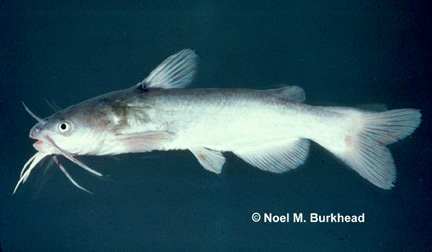
The white catfish, native to the Atlantic coastal states, was introduced into California in 1874, and spread rapidly throughout the state. By 1880, the Fish Commission asserted that catfish were present in every county in California (Dill and Cordone, 1997).
Growing to 10 to 14 in (25-35 cm) and weighing between 0.5-3 lbs (0.25-1.4 kg), white catfish vary in color, however the sides are generally blue-gray to blue-black with a pale silver-white underside. These colors can be much darker, particularly the head, lips, and barbels, in murky water and especially in breeding males. The entire body is smooth and possesses a lustrous sheen, and the chin barbels (or “whiskers”) are similar in color to the adjacent body parts.
Historically, black bass in California consisted of four non-native species: largemouth bass (M. salmoides), smallmouth bass (M. dolomieu), spotted bass (M. punctulatus), and redeye bass (M. coosae) (Moyle, 2002), with the first 3 species known to reside in Deer Creek. The term “black bass” refers to members of the sunfish family (Centrarchidae) that are within the genus Micropterus.
The history of bass introductions in California is murky and confusing due to poor record keeping and the lumping of several species together as black bass (Dill and Cordone,1997). Native to the eastern region of the United States, bass predation is considered a threat to native California fish populations and a contributing factor to their declines.
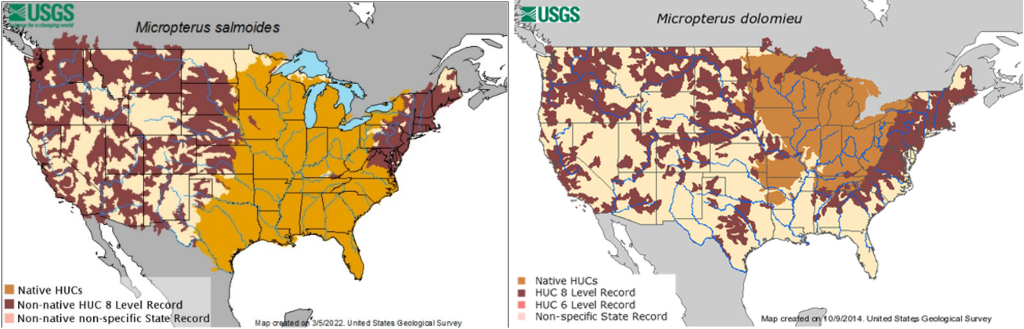
Now abundant and widespread in California, black bass prey on other fish and invertebrates, and live in waters with wide-ranging water quality (Moyle 2002), with black bass species providing popular fisheries for anglers.
Now that you know what to look for in the creek, happy fish-watching! If you are heading out for angling, always check local fishing regulations, water access rights and land ownership in advance. Additionally, many fish have recommended human consumption limits due to the presence of mercury in their tissues, a by-product of the mining industry and known to occur in Deer Creek.
Dill, W. A., and A. J. Cordone., 1997. History and status of introduced fishes in California, 1871-1996. Manuscript for Fish Bulletin of the California Department of Fish and Game 178.
Moyle, P. B., 2002. Inland Fishes of California, Revised and Expanded. Berkeley. University of California Press.
Pasternack, G. B., Fulton, A. A., and Morford, S. L. 2010. Yuba River analysis aims to aid spring-run Chinook salmon habitat rehabilitation. California Agriculture 64:2:69-77.
Rypel, A.L., Saffarinia, P., Vaughn, C.C., Nesper, L., O’Reilly, K., Parisek, C.A., Miller, M.L., Moyle, P.B., Fangue, N.A., Bell‐Tilcock, M. and Ayers, D., 2021. Goodbye to “rough fish”: paradigm shift in the conservation of native fishes. Fisheries 46(12): 605-616. https://doi.org/10.1002/fsh.10660T
Yoshiyama RM, Gerstung ER, Fisher FW, Moyle PB., 1996. Historical and present distribution of Chinook salmon in the Central Valley drainage of California. In:
Sierra Nevada Ecosystem Project: Final Report to Congress, Volume III. Centers for Water and Wildland Resources, University of California, Davis. Davis, CA. Pg. 309-361.