Field Season Recap!
Now that we head into fall, it’s a perfect time to reflect on our 2026 monitoring field season here ...

If I wanted a friend to experience the wonder and mystery of Oaks, I would take them down Jones Bar Road. Tromping through these hills and ravines I’ve come across a surprising concentration of Oak species, some spectacular specimens, and a few curious little trees with perplexing combinations of traits.
Over the past couple of years, my drive from Nevada City out to Jones Bar Road has become a familiar commute. In my mental map, a sequence of landmarks (trees, mostly) marks the way. A recently-deceased Douglas-Fir and a patch of Lilies along Highway 49, left at the Willo Steak House onto New Town Road. A roadside thicket of Whiteleaf Manzanita with a thick carpet of Sonoma Sage spreading through its shade, pink Chaparral Pea, past an old friend’s driveway. Up onto a ridge where that familiar, dense mix of Ponderosa Pine, Incense-Cedar and more Manzanita gives way suddenly to a sparse landscape of McNab Cypress, Grey Pine and stunted Ceanothus braving the strange chemistry of green-grey serpentine soil.
As I approach my turn, a tangle of broken and charred snags on my right marks the place where the Jones Fire stopped after burning through a quarter-mile wide swath up from the South Yuba River in August of 2020. Throughout the scar skeletons of old, burned Oaks have re-started their lives post-fire as shrubs, their spiny-leafed shoots erupting from the bases of their decaying trunks.
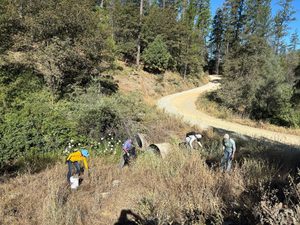
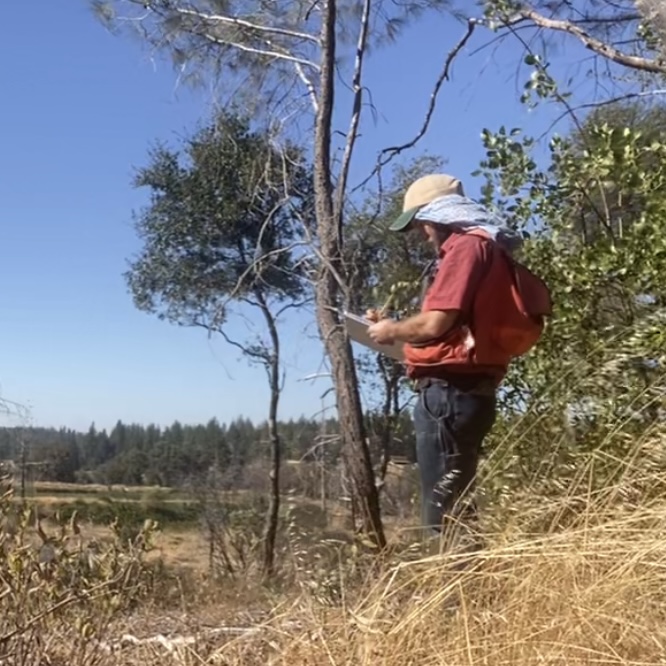
I come out here each week to work in various capacities on the Sierra Foothills Forest and Climate Resilience Project, a landscape-scale effort to improve wildlife habitat and steward the land toward greater resilience to wildfire and drought. I flag areas to be masticated, record the effects of prescribed burns, and chat with land owners about how to continue caring for their recently-thinned portion of forest. But whatever I’m out there doing, I’m always noticing the Oaks.
Of the twenty or so species of Oaks found in California,[2,3,4] at least six of them (plus a hybrid or two) live in this neighborhood. Perched above the South Yuba River canyon, the Jones Bar Firewise Community encompasses much of the Owl Creek and Rush Creek drainages from New Town Road down to the South Yuba. Within this landscape, dry and rocky ridges, cool creek basins, shady north-facing slopes and sun-baked south-facing hillsides create micro-climates and diverse niches for unique plant communities to occupy. Running through all of this, occasional bands of serpentine soil add another dimension of diversity. Naturally rich in magnesium and heavy metals but low in calcium, this soil selects for a subset of local plants who can make do in such a harsh growing medium. [1]
The diversity of Oaks in Jones Bar might be attributed in largest part, though, to its particular elevation. Oaks, like many plants in California, situate themselves along suitable elevation bands encircling the Great Central Valley. An observant eastbound road-tripper on Highway 20, for example, could notice gradual transitions from the Valley Oaks along the creeks and grasslands of the Central Valley, up through the rolling Blue Oak savannas and Interior Live Oak woodlands of the foothills, into Black Oaks mixed amongst conifer forests climbing to elevations over 6,000 feet, nearly to the crest of the Sierras. But here, between 1,000 feet in the river canyon to about 2,000 feet on its ridges and hilltops, the Jones Bar neighborhood sits at a rich transition zone where all these species and more converge.
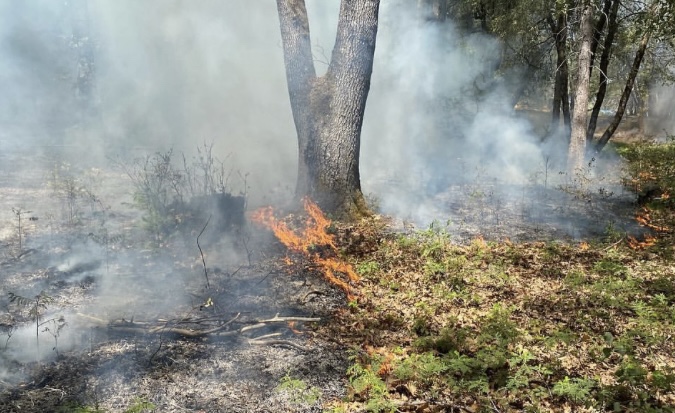
The more time I spend with these remarkable creatures, the more unanswered or unanswerable questions I find myself sitting with. I ponder the complexity and nuance of their relationships with Wasps, Jays, Mistletoe, Humans, and Fire. In the Spring after a prescribed burn, the Oaks show a range of responses to the fire. Some look unscathed, except for a singe on the moss that covered their trunks. Others are shaggy with leafy growth all along their trunks and branches, new shoots from epicormic buds that laid dormant beneath the bark until some stimulation set them to sprouting. Where heat was more intense, top-killed trees look dead but at their base, their roots feed dozens of vigorous new stems. Others, indeed, are dead.
I wonder what these trees and this forest will look like in two or twenty or two-hundred years. Under what conditions might one of these gangly, crowded Black Oaks become one of those giants with a trunk too big to hug and a crown high and wide enough for a hundred people to celebrate a season’s harvest in its shade? I wonder what this landscape looked like two-hundred or two-thousand years ago when fire, from lightning and Nisenan ancestors, moved through here more frequently.[2,6] Or what it might have looked like here after another two hundred years of (attempted) fire exclusion. And could these Oaks that are now top-killed and stump-sprouting have been the top-killed stump-sprouters after the 49er fire almost forty years earlier? Then how old are their roots?
Some of these questions have answers, I just haven’t learned them yet, or maybe I never will. Some don’t have answers at all, but all of them are worth carrying with me. They keep me coming back to see the changes for myself, they lead me to new questions, and they pull me into a relationship with these trees that’s filled with curiosity, awe, and hopefully some kind of reciprocity.
For those who might feel inspired to meet these Oaks in person or just read about them here, I’d like to offer a brief introduction plus a few more of my unanswered questions:
Below 5,000’
Evergreen
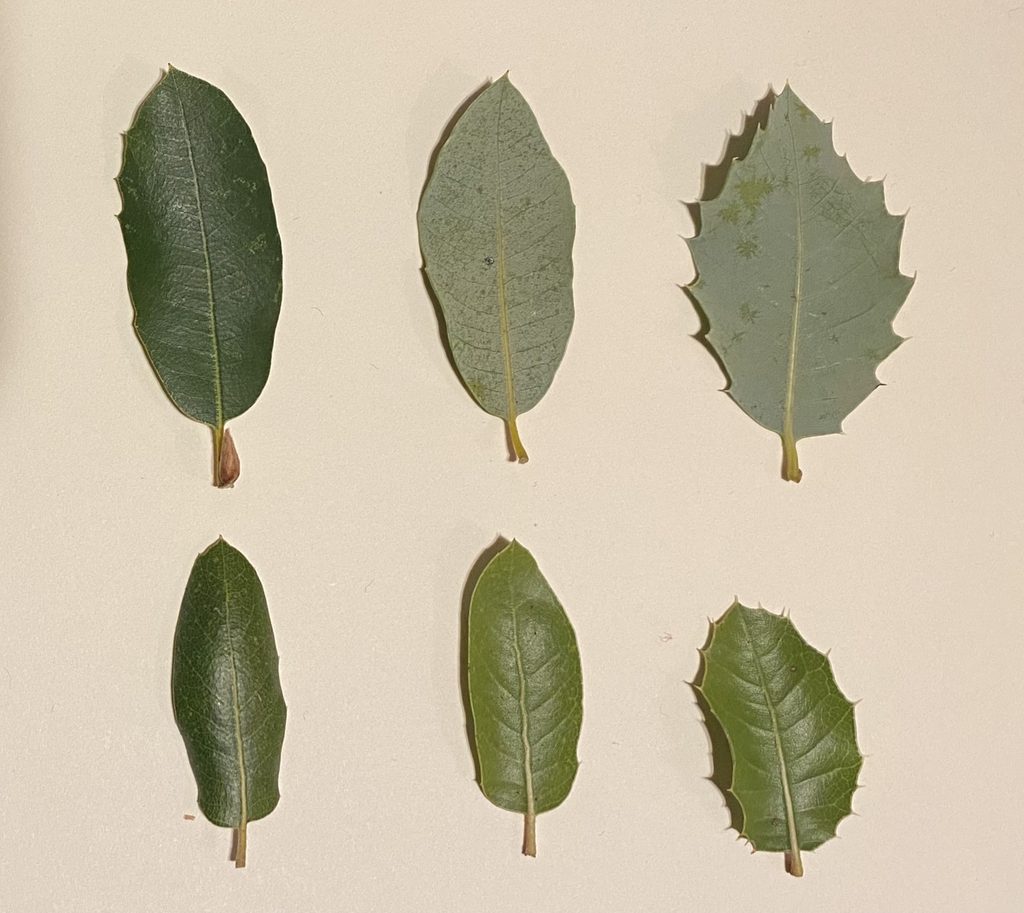
The only member of the “Golden” or “Intermediate” Oak group found at these elevations, the Canyon Live Oak is the close relative of the shrubby Huckleberry Oak found higher in the Sierras. Canyon Live Oak can be mistaken for Interior Live Oak, but a few key differences can help us tell them apart. Take a look at the underside of a leaf. If it is a dusty turquoise color and slightly fuzzy, you are probably looking at a Canyon Live Oak. If it is just a slightly yellower shade than the color on the top side of the leaf, you are probably looking at an Interior Live Oak. Another difference, Canyon Live Oaks have big, bumpy, round acorn caps covered in a soft golden fuzz. Interior Live Oak has acorn caps more closely resembling those of Black Oak, with their flaky red-brown shingles. [4,5]
Elevation: 1,000 to 6,000’
Deciduous
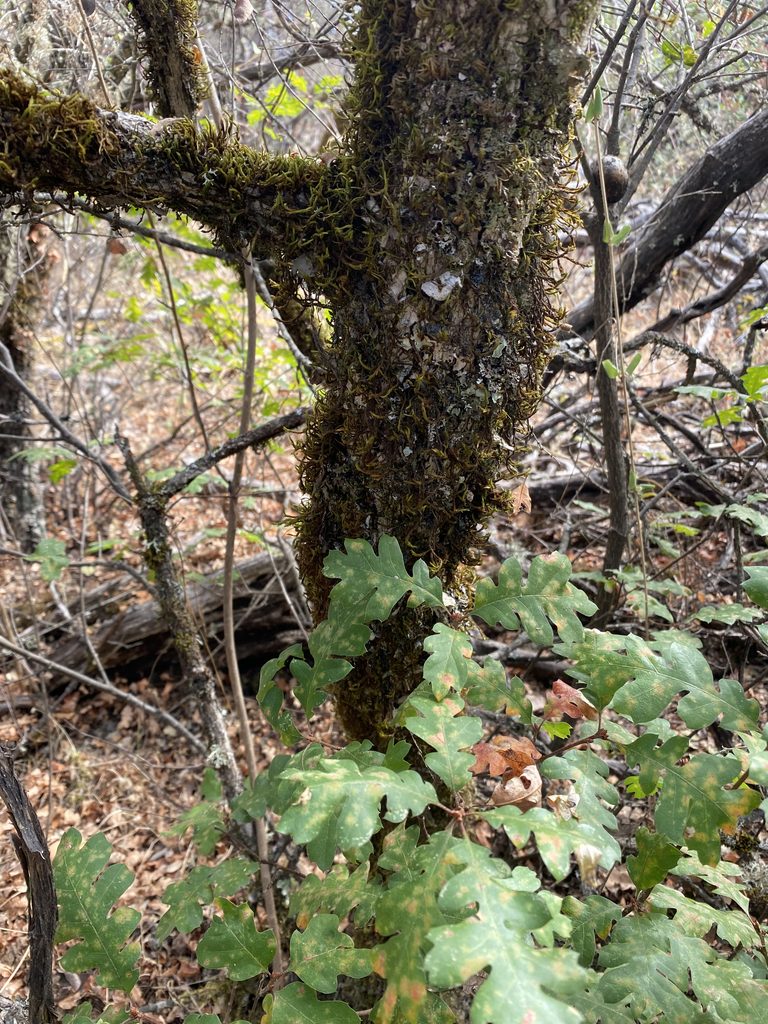
An important member of oak woodland and lower mixed conifer forest communities, these Oaks produce nutritious acorns that feed Squirrels, Bears, Deer, Jays, Quail, Woodpeckers, and Humans. Their deeply-lobed and soft-bristle-tipped leaves emerge in the spring, bright green or purplish-red at first, a deep velvety green through Summer, and turn yellow, orange, red or brown before dropping in Fall. Black Oaks can live over 500 years and reach over 80 feet tall. [4,5]
Elevation: Below 3,000
Evergreen
Interior Live Oak grows thick, checkered, grey bark that helps insulate its cambium layer from the heat of fire. To add to our confusion distinguishing it from Canyon Live Oak, both can exhibit a range of leaf shapes on a single tree. Often in response to cutting, browsing, fire, or other stressor, Live Oaks can grow stiff, spiny leaves with sharp points along their margins. Elsewhere on the tree, leaves grow with smooth edges that come to a single point at the tip. [4,5]
Elevation: 1,000-3,000’
Semi-deciduous
As members of the “Red Oak” group, California Black Oak and Interior Live Oak can hybridize with each other to produce a tree known as Oracle Oak. [4] These trees share traits of both parent species, and vary in their degree of “deciduous-ness” from year-to-year and tree-to-tree. Their leaves, usually more rigid than Black Oak but larger and more lobed than Interior Live Oak, can be spotted throughout Fall and into Winter with a smattering of green-and-yellow leaves clinging to their branches, as if unsure in which parent’s footsteps to follow. [3,4]
I wonder how often these hybrids produce viable acorns. If they reproduce, are they pollinated by Black Oaks or Interior Live Oaks? Then what would those next generations look like? Does this create a spectrum of genotypes and phenotypes? Could some of the trees we see that look like Black Oaks be carrying Interior Live Oak genes? If they are, could particular combinations of genes from these species be advantageous for an individual tree in a given environment? Is this hybridization an adaptive strategy? What even is a “species” anyway?
Below 2,000’
Deciduous
These spectacular Oaks are the largest in California. They are uncommon in the Jones Bar area, typically growing at lower elevations in the Sierra foothills, in the Central Valley and the Coast Ranges.
Below 3,000’
Deciduous
Blue oaks have learned a clever trick to survive the Sierra foothills’ hot, drought-prone summers: when temperatures are high and water is scarce, these oaks can drop their leaves and go dormant, reducing water lost to transpiration. [4,5]
2,000-6,000’
Deciduous
This small, shrubby variety of Oregon White Oak (Quercus garryana) could easily be mistaken for a small Black Oak. Semota White Oak leaves tend to be smaller than Black Oak leaves but have a similar shape. [4,5]
Maybe Quercus douglasii x Quercus garryana var. semota hybrid?
Elevation: ~1,300-1,800’
In several locations in the Jones Bar neighborhood, stands of shrubby trees can be found seeming to exhibit traits of both Blue Oak and Semota White Oak. They reach about 6-15’ often with curving and re-curving stems. They have the peeling, white bark of Blue Oaks, but the more deeply-lobed leaves and shrubbier, multi-stemmed growth form of Semota White Oaks. I have also found similar specimens a few miles north on Cement Hill. Blue Oak (Q. douglasii) and Oregon White Oak (Q. garryana) are known to hybridize,[4,5] although I have not found any references to this specific Semota variety (Q. Garryana var. semota) hybridizing with Blue Oak. Both Semota White Oak and Blue Oak have been present nearby wherever these oaks in question have been found.
As much time as I spend inspecting these Oaks, I am still learning, and could certainly be misidentifying a more familiar species that’s exhibiting some physical traits I’m not familiar with. Maybe they’re growing differently in response to soil conditions, shade, browsing by deer, or something else I haven’t considered.
Thanks for reading my musings on Oaks. Please share any Oak questions of your own, or answers you may have to mine.
[1] Alexander, E.B. et al. Serpentine Geoecology of Western North America, Geology, Soils, and Vegetation. Oxford University Press, 2007
[2] Anderson, M. Kat. Tending the Wild: Native American Knowledge and the Management of California’s Natural Resources. University of California Press, 2005.
[3] Nixon, Kevin C. “The Oak (Quercus) Biodiversity of California and Adjacent Regions”. Proceedings of the Fifth Symposium on Oak Woodlands: Oaks in California’s Challenging Landscape. Albany, CA: Pacific Southwest Research Station, Forest Service, U.S. Department of Agriculture, 2002.
[4] Trees and Shrubs of Nevada and Placer Counties, California. California Native Plant Society, Redbud Chapter, CNPS Press, 2014.
[5] Stuart, John D., Sawyer, John O. Trees and Shrubs of California. University of California Press, 2001.
[6] Van de Water, K.M., Safford H.D. A Summary of Fire Frequency Estimates for California Vegetation before Euro-American Settlement. Fire Ecology Volume 7, p. 26-58 (2011)