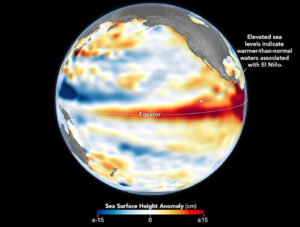
What is this forecasted “Strong El Niño”? Updates on expectations for California/Nevada
This post includes data and information provided by Bob Stefanski, retired Chief of the WMO Agricult...

As many of you in our Sierra Streams Institute community are aware, we try to be fairly picky and measured with regards to public comment on issues that span the gap between science and activism. In fact you’ve probably heard us use the phrase “we don’t do advocacy, we do advocacy through evidence”; as a community science organization, our goal is first and foremost to speak to data, evidence, and robust scientific interpretation of the world around us. This stems from a classic view that science should be unbiased and apolitical. Indeed, (to be a broken record) science is inherently apolitical.
But science is also under attack by political means. If you have not heard, a new proposed rule from the Federal Management and Budget Office (OMB) would represent some of the most sweeping and restrictive changes to the federal funding landscape for research in history, including installation of political appointees to oversee previously peer-reviewed research grant decisions and new rules to allow the cancellation of funding mid-project with shifting federal priorities. SSI will share our open letter and comment submission as it comes together, but in the interim with the closing comment period, we are calling on you to speak up for unbiased science. Below is a brief summary of some of the most relevant new proposed rule changes, followed by links to some scientific society comments and responses to these changes.
Remember, science is a process, and choosing to continue to defund science serves only to canalize American thought into a single trajectory by destroying curiosity, stunting societal growth, and devaluing the exploration of our world.
[200.205] Pre-issuance review by political appointees, with peer review demoted to advisory.
[200.205] “Gold Standard Science” as an undefined test
The standard process for grant submission to federal funding sources such as the National Science Foundation or National Institutes of Health has long been the classic academic gold standard (more on that term below): peer review. This means that those reviewing a proposal for research funding are fellow peer experts in the field of study. These proposed rules instead allow political appointees to overrule and decide on research direction with no knowledge of the field they are reviewing. In fact, the provision explicitly states that awards must “…demonstrably advance the President’s policy priorities,” giving political appointees a veto over any science that conflicts with an administration’s ideology. This same provision then goes on to use a loosely defined new standard of “Gold Standard Science”; gold standard science is by definition peer reviewed and not funded based on political ideation. Any application of this provision inherently biases any and all federal funding for research, hamstringing robust and independent scientific discovery.
[200.206] Affiliation-based denial
This provision allows for denial of research funding entirely based on affiliation (also loosely defined); the aforementioned political appointees may choose to not fund a project simply because the researchers have personal or professional affiliations that the reviewer is not fond of. Such a policy also defers to any inherent bias of the appointee, leading to systemic bias in funding availability and thus final research completion.
[200.340] Mid-award termination for shifting “priorities.”
This provision allows for “convenience terminations” of awards with shifting priorities without any explanation. For reference, SSI was already on the receiving end of one such termination, having a National Science Foundation award halted mid-project last year due to flagging of included terminology around science, learning, ecological information, and tribal knowledge. The sudden halting of an award like this sends recipient organizations, partners, staff, and the research community in which the award applies into disarray; science (in particular ecological/natural science) takes place over long time frames, requiring multiple observations and analyses of patterns to draw any meaningful conclusions. The uncertainty injected into the research world by this rule means long term research that actually confirms or denies potential correlations and mechanisms (because remember, correlation doesn’t equal causation!) is effectively dead in the water unless states and foundations pick up the funding slack (which is fiscally impossible).
[200.432 and 200.461] Removing funding for professional activities and affiliations
This provision removes allowance for funding of conference attendance or academic publication costs. The primary venue of scientific debate, whereby ideas are proposed and then tested, shot down, or validated, is the combination of academic journals and conferences. While this system has its flaws (as we have discussed and will continue to discuss in our “Principles of Sound Science” blog series), including high publication costs (sometimes in the thousands of dollars per page), these issues stem from the system in which those journals operate, not the researchers who could not otherwise find funding support for publication. Further, most modern journals have shifted to digital publication, with publication fees primarily being associated with “open access”; by restricting funding for publication, taxpayer dollars allocated to research are then used for research that will continue to sit behind a paywall, rather than paying the cost to make it truly free to everyone. By removing these components from research proposals, the “court of public scientific opinion” closes even more, slowing idea discovery and hypothesis testing to a crawl.
[200.218 and 200.300] Restrictions on funding based on terminology
This provision connects to the executive orders discussed last year, whereby terms are “flagged” as being in violation of federal policy surrounding “unfair” DEI policies. Beyond the obvious moral and ethical implications of reducing funding to create truly equal access to science, the “trickle down” impact of this politicization of terminology has already been seen in flagging of terms like diversity, which can apply to everything from gender, race, and biological diversity, or climate change, which is a simple descriptor of an agreed upon process of atmospheric and downstream changes. This further invalidates the “gold standard science” provision listed above, as here political interpretation of terms outweighs actual scientific definition.
Below are links to scientific society website who go into further detail about these changes with some ways that you can provide public comment:











Lang Waters says:
This is simply horrific. I’ll be taking action.
Sam Bell says:
Thanks Lang!
Inge says:
I just submitted comments to the federal register.
The new proposals put the scientific research environment upside down. The US will lose its scientific edge to other countries.
Sam Bell says:
Thank you Inge!